
Filters
Level
Grade
Subject
Subject Area
Subject Topic
Standard(s)
Audience
Keyword
DurationMinutes
5th Grade Lesson Plans

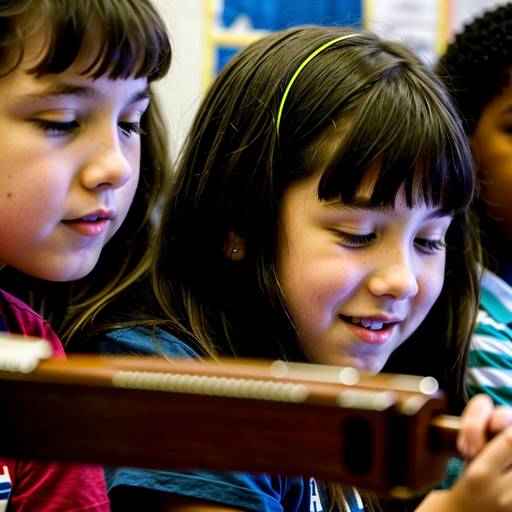
In this 5th Grade music lesson, students will explore the concept of harmony in singing. The session begins with a brief discussion about harmony and its emotional impact when multiple voices blend together. After a vocal warm-up to build confidence, students will participate in a listening exercise to identify harmonies in various musical pieces. The class will then be divided into groups to learn and practice different vocal parts of a selected song, fostering teamwork and collaboration. The lesson concludes with a reflection on their experiences and a final performance of the song, showcasing their ability to sing in harmony. Assessment will focus on student engagement and performance quality, while extensions may include exploring additional songs and arranging a performance for an audience.

In this 5th-grade social studies lesson, students will explore the Civil Rights Movement through engaging activities designed to enhance their understanding of key events, figures, and the movement's historical context. The lesson begins with a warm-up discussion about civil rights, followed by a presentation that highlights significant figures and major events, such as the Montgomery Bus Boycott and the Civil Rights Act of 1964.
Students will then work in small groups to analyze primary source documents related to assigned events before presenting their findings to the class. The second day focuses on creating a collaborative timeline that incorporates the key events discussed, allowing students to visually connect the significance and interrelationships of the events in the movement.
The lesson concludes with a reflection activity, where students write about their insights and how the historical events relate to contemporary society. Assessment will be based on group participation, presentations, and the completion of reflective writing. Opportunities for extension activities, such as guest speakers or field trips, are also suggested to deepen students' engagement with the subject matter.
In this fifth-grade social studies lesson, students explore the concepts of community and diversity. The lesson begins with a class discussion to define what makes up a community and the importance of diverse cultures and backgrounds. Students are then divided into small groups to create a visual representation, called a "Community Diversity Map," that highlights various cultural elements present in their neighborhood. Through drawing and collage-making, they reflect on their own backgrounds while appreciating the contributions of their peers.
After completing their projects, each group presents their map to the class, fostering discussion on the significance of diversity and similarities within their community. To conclude, students reflect individually on their learning experience through a worksheet, allowing them to express new insights and ways to celebrate diversity. This engaging lesson aims to promote understanding and appreciation of the unique voices that compose their community.

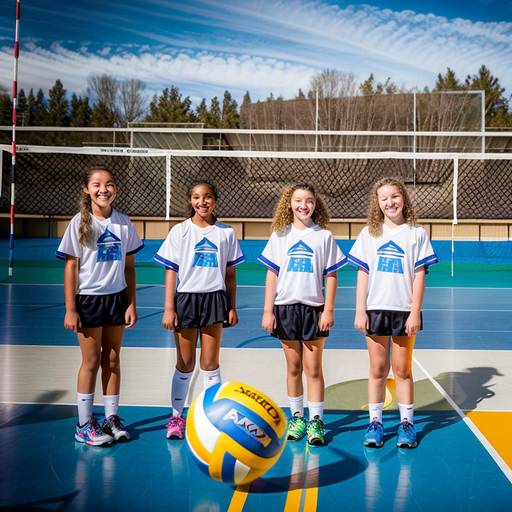
In this 5th-grade physical education lesson, students will engage in learning fundamental volleyball skills, including passing, setting, and serving, while emphasizing the importance of teamwork and communication. The lesson begins with a dynamic warm-up to prepare students physically. Following the warm-up, students will be introduced to the basic rules of volleyball and the skills they will practice.
The class is divided into small groups, rotating through skill stations where they will practice each technique under guidance. After mastering the skills, students will participate in friendly volleyball matches, allowing them to apply what they have learned in a game setting. The lesson concludes with a cool-down period that includes static stretching and a group discussion for students to reflect on their learning experiences.
Assessment will focus on observational evaluation during skill activities and team play, as well as self-reflection on individual progress. Modifications will be provided for students who need additional support, ensuring that all participants can engage meaningfully. Overall, this lesson aims to foster not only physical skills but also collaboration and camaraderie among students.

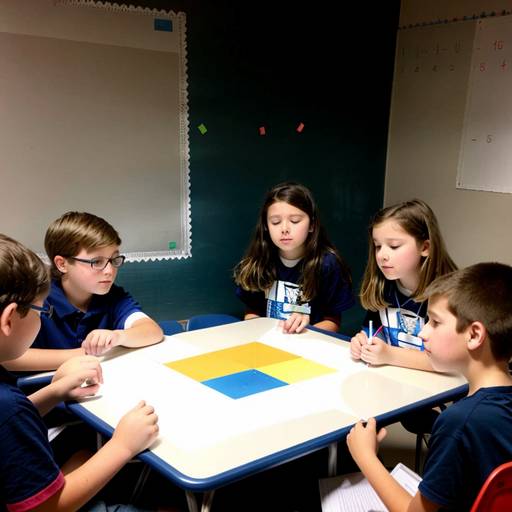
In this 5th-grade math lesson, students will explore the concept of volume by engaging in both theoretical and hands-on activities. They will begin with a discussion on the meaning and importance of volume, followed by an introduction to the formula for calculating the volume of rectangular prisms (V = length × width × height).
After practicing measurement techniques with rulers, students will work in pairs to measure the dimensions of rectangular boxes and calculate their volumes. They will then participate in a group activity where they fill the boxes with sand or water, comparing their predicted and actual volumes.
The lesson culminates with a regrouping session where students will share their findings and insights, reinforcing key concepts discussed. Assessments will include reviewing worksheets to gauge understanding and observing group dynamics during activities. Differentiation strategies will be employed to support varied learning needs, while an extension activity will encourage students to discover volume in everyday objects at home.
In this fifth-grade math lesson focused on measurement and volume, students will explore the concept of volume through hands-on activities and practical applications. The objectives include understanding how to calculate the volume of rectangular prisms using the formula \( V = l \times w \times h \), as well as developing measuring skills with rulers and measuring tapes.
The lesson begins with a brief discussion of volume and its real-world relevance. Students will then learn how to measure the dimensions of a box and calculate its volume through guided practice. After measuring, students will fill their boxes with water or rice, allowing them to visualize and compare their calculated volume with the actual capacity.
As the lesson concludes, groups will share their findings and reflect on their experience. Assessment will be based on observation of group work, completion of worksheets, and journal reflections on what they learned. Extension activities may include exploring volumes of more complex shapes, while adaptations will be made to accommodate diverse learning needs. Overall, the lesson aims to impart a comprehensive understanding of volume through engaging, hands-on experiences.

In this 5th-grade physical science lesson, students will explore the concepts of energy, motion, and waves through engaging hands-on activities. The lesson begins with a discussion about everyday examples of energy, followed by a video illustrating different types of energy in action. Students will work in small groups to conduct experiments, such as launching small balls with rubber bands and creating waves using strings and shallow trays of water.
Throughout these activities, students will make observations about how energy affects motion and how it travels in waves. After the exploration phase, the teacher will lead a discussion to clarify scientific concepts such as kinetic and potential energy, reinforcing students' understanding through their observations. To encourage critical thinking, students will reflect on the role of energy in their daily lives.
To evaluate comprehension, students will complete a worksheet that asks questions about their experiments and the principles of energy and waves they learned. The lesson concludes with ideas for follow-up activities, including a potential science fair where students can showcase their own energy-related experiments. By the end of the lesson, students will have a solid understanding of the fundamental principles of energy and motion in the physical world.

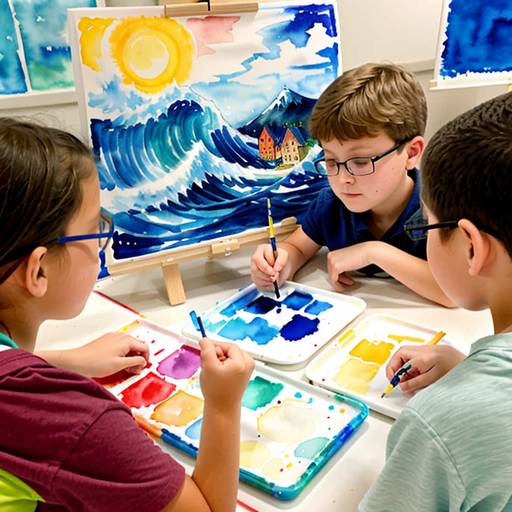
This 5th-grade art lesson focuses on exploring various watercolor techniques while encouraging creativity and self-expression. Over two class periods, students will learn and practice techniques such as wet-on-wet, wet-on-dry, and dry brush. By observing and discussing famous watercolor artworks, they will gain insight into the medium's history and applications.
In the first session, a demonstration will highlight each technique, followed by guided practice where students can experiment with colors and techniques on their own. After sharing their experiences in small groups, students will prepare to create their own final artwork.
In the second session, students will sketch their ideas and then paint their compositions using at least two techniques learned. After completing their artworks, a gallery walk will allow them to showcase their creations and provide feedback to peers. The lesson concludes with a reflection, discussing challenges faced and insights gained throughout the process.
Assessment will focus on their application of techniques and overall creativity, while optional extensions may include researching famous watercolor artists or collaborating on a class mural. The lesson aims to enhance students' artistic skills and foster a deeper appreciation for watercolor painting.
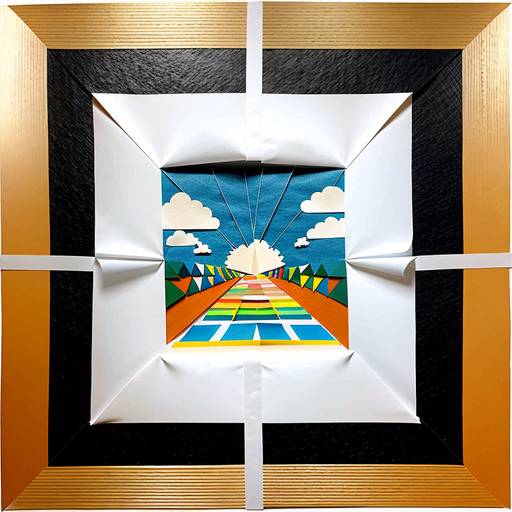
In this 5th-grade art lesson, students will explore the art of collage as a medium for storytelling. The session begins with a discussion on the definition and examples of collages, emphasizing their ability to convey personal narratives. Students will learn various art techniques, such as layering and creating textures, through a guided demonstration. They will then have the opportunity to create their own collages, using a variety of papers and materials to express a chosen story or experience. Throughout the process, collaboration and sharing ideas with peers will be encouraged. At the end of the lesson, students will participate in a gallery walk to showcase their work and reflect on their creative journey, fostering a deeper understanding of art techniques and personal expression. Assessment will be based on creativity, narrative clarity, technique use, and overall effort. An extension activity involving digital collages will further enhance their learning experience.
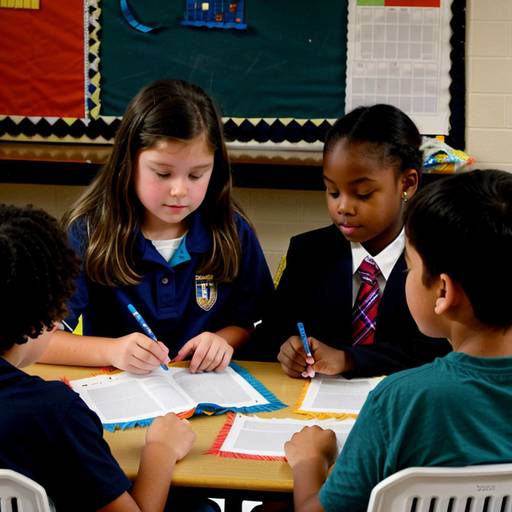
In this 5th-grade social studies lesson, students will explore the various roles within their community and understand the responsibilities associated with each role. The lesson begins with a class discussion that prompts students to identify different roles, such as teachers, firefighters, and city officials, and considers how these roles contribute to community functioning. Following a mini-lecture that provides an overview of key roles and their responsibilities, students will work in small groups to research a specific role assigned to them. They will then create a visual representation, such as a poster or collage, highlighting the importance of their assigned role. The lesson concludes with presentations and a reflection on the significance of community involvement. Assessment will be based on group participation, the quality of visual representations, and involvement in discussions, while extension activities may include inviting community members or organizing field trips to see these roles in action.