

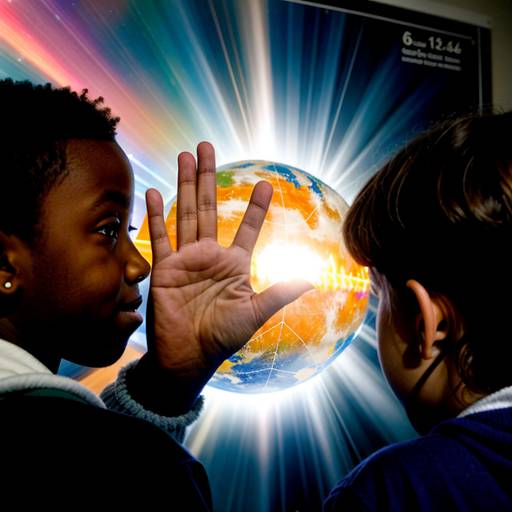
In this 5th-grade physical science lesson, students will explore the concepts of energy, motion, and waves through engaging hands-on activities. The lesson begins with a discussion about everyday examples of energy, followed by a video illustrating different types of energy in action. Students will work in small groups to conduct experiments, such as launching small balls with rubber bands and creating waves using strings and shallow trays of water.
Throughout these activities, students will make observations about how energy affects motion and how it travels in waves. After the exploration phase, the teacher will lead a discussion to clarify scientific concepts such as kinetic and potential energy, reinforcing students' understanding through their observations. To encourage critical thinking, students will reflect on the role of energy in their daily lives.
To evaluate comprehension, students will complete a worksheet that asks questions about their experiments and the principles of energy and waves they learned. The lesson concludes with ideas for follow-up activities, including a potential science fair where students can showcase their own energy-related experiments. By the end of the lesson, students will have a solid understanding of the fundamental principles of energy and motion in the physical world.
| Level | Elementary School |
| Grade | 5th Grade |
| Subject | Science |
| Subject Area | Physical Science |
| Subject Topic | Energy |
| Age Range | 10 to 11 |
| Audience | Group |
| Language | English |
| Duration | 60 mins |