
Filters
Level
Grade
Subject
Subject Area
Subject Topic
Standard(s)
Audience
Keyword
DurationMinutes
Elementary School Lesson Plans

In this 60-minute language arts lesson for 2nd graders, students learn about essential punctuation marks—including periods, question marks, and exclamation points—and their importance in constructing complete sentences. The lesson begins with a discussion highlighting the significance of punctuation in communication.
Following a direct instruction segment, where the teacher models sentence examples without punctuation, students participate in identifying the correct punctuation needed for each sentence. Guided practice involves completing a worksheet together, while independent practice allows students to finish sentences on their own, with an option to illustrate their work.
The session concludes with a review where students share their sentences and discuss their punctuation choices, reinforcing their understanding of nouns and verbs. Assessment includes observation during activities and reviewing completed worksheets for accuracy in punctuation usage. The lesson is designed to promote engagement, collaboration, and creativity while reinforcing key grammar concepts.
In this 5th-grade Language Arts lesson plan focused on grammar and capitalization, students will learn the essential rules for using capital letters correctly in writing. The lesson begins with an engaging discussion about the importance of capitalization, followed by the introduction of basic rules through a handout. Guided practice involves identifying and correcting capitalization errors in sentences on the whiteboard.
Students then work in pairs to read a short story filled with intentional capitalization mistakes, highlighting and correcting them collaboratively. After sharing their corrections with the class, students apply their knowledge by writing a short paragraph about their favorite holiday or activity, ensuring to use proper capitalization.
The lesson concludes with a recap of key concepts and a review of student work. Assessments include observing participation, evaluating corrected stories, and reviewing the written paragraphs. Adaptations are provided for varying skill levels, and a follow-up activity encourages creativity through photo captioning while reinforcing capitalization rules.
In this 4th-grade Language Arts lesson, students will explore the basics of grammar, focusing on nouns, verbs, and adjectives, as well as proper punctuation marks such as periods, question marks, and exclamation points. The lesson begins with a discussion on the importance of grammar and punctuation, illustrated with examples that highlight how these elements can change the meaning of sentences.
Following direct instruction, students will engage in a group activity where they work together to build creative sentences using provided words, ensuring correct grammar and punctuation usage. Each group will present their sentences to the class, allowing for peer feedback. Afterward, students will complete an independent worksheet that reinforces the concepts learned.
The lesson concludes with a brief review, encouraging students to reflect on their new knowledge, and it offers a creative homework assignment where they will apply what they've learned by writing a short story. Throughout the lesson, students are guided to collaborate, think critically about language use, and express their creativity while enhancing their grammar and punctuation skills.
In this lesson plan for 3rd-grade language arts, students will explore the essential role of punctuation in writing. The lesson begins with an engaging introduction that highlights why punctuation is important and how it influences the meaning of sentences. Following a guided demonstration, students will work in pairs to identify and apply various punctuation marks—periods, commas, question marks, and exclamation points—on worksheets designed to help them practice.
For independent practice, students will select sentences from short stories and rewrite them with the correct punctuation, allowing them to express their creativity. The class will then share their punctuated sentences, fostering discussion about their choices. The lesson concludes with a recap of key points, where students reflect on their learning about punctuation, leading to the distribution of rewards for participation and achievement throughout the session. Assessment will be based on observation during activities and the completed worksheets to evaluate students’ understanding of punctuation. Modifications are included to support learners of varying levels. Overall, the lesson aims to make grammar and punctuation engaging and accessible.

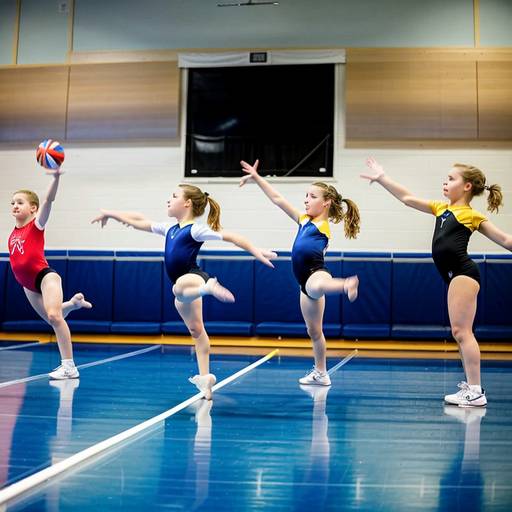
This lesson plan is designed for 5th-grade students and focuses on developing movement, balance, and teamwork through gymnastics and sports-related activities. The session begins with a warm-up that includes light jogging and dynamic stretches, followed by an introduction to key gymnastics skills such as forward rolls, cartwheels, and balance techniques.
Students are divided into small groups and rotate through skill development stations, allowing them to practice each gymnastics movement with partner support. Additionally, a coordination station with hula hoops is included to enhance their agility. A team challenge, featuring a relay race that incorporates the skills practiced, fosters collaboration and sportsmanship among students.
The lesson concludes with a cool-down stretching session and a reflective discussion about the importance of balance, coordination, and teamwork. Overall, the plan aims to engage students in physical activity while promoting positive social interactions and fitness.

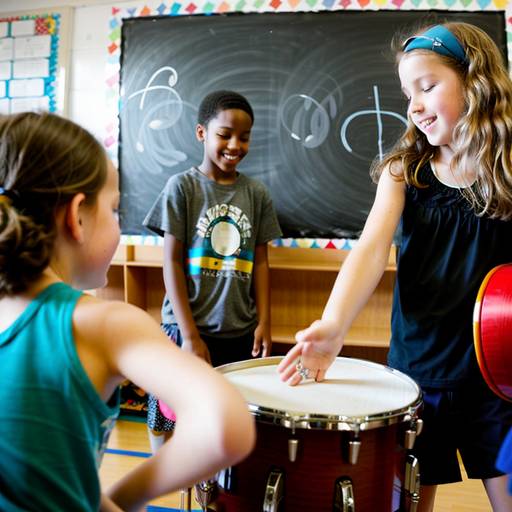
In this 5th-grade music lesson, students will explore the concept of rhythm through a combination of clapping, movement, and percussion instruments. The session will begin with a clapping exercise to warm up and introduce the idea of rhythm, followed by a discussion on its importance in music and daily life. Students will learn to read basic rhythmic notations including quarter notes, eighth notes, half notes, and rests through guided practice.
The lesson includes interactive stations where students engage in body percussion, play percussion instruments, create movement sequences, and compose their own rhythmic patterns in small groups. After rotating through the stations, students will have the opportunity to share their creations with the class, promoting collaboration and creativity.
The lesson concludes with a reflection on what they learned and how they can incorporate rhythm into their everyday lives. Assessment will be based on observation during activities and evaluation of group presentations. Additionally, there are suggestions for extensions to further develop students' understanding of rhythm, including more complex patterns.
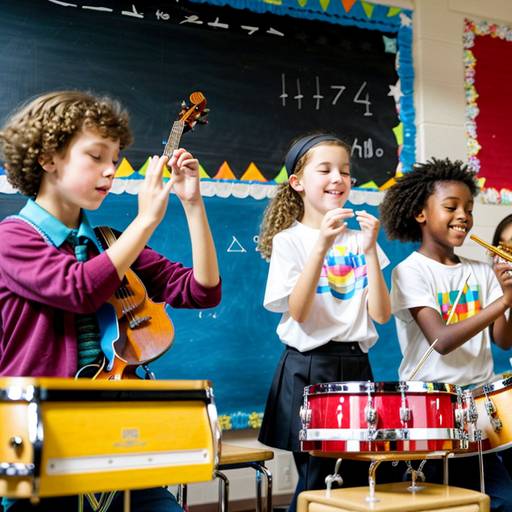
In this 4th-grade music lesson, students will explore fundamental concepts of music theory, focusing on rhythm and note values. The lesson begins with a rhythm echo exercise to engage students and introduce the importance of rhythm in music and everyday life. Students will learn about basic note values—whole notes, half notes, quarter notes, and eighth notes—through visual aids and clapping exercises.
Following this introduction, students will work in small groups with percussion instruments to create and rehearse their own rhythmic patterns, combining at least two different note values. Afterward, the class will unite to form a "Rhythm Band," performing their patterns together over a steady background beat, emphasizing collaboration and the layering of rhythms.
To conclude, students will reflect on their learning experience, discussing the significance of rhythm in music and teamwork. They will be encouraged to practice rhythm patterns at home, reinforcing their understanding of the concepts taught. Assessment will involve observing group dynamics, listening to performances, and a short worksheet on note values and rhythm creation. This interactive approach aims to enhance students' musical skills and foster creativity.
In this Kindergarten music lesson, students will explore foundational concepts of rhythm through engaging activities involving clapping, body percussion, and percussion instruments. The lesson begins with a welcoming song to introduce rhythm as a pattern of sounds and silences. Following an activation of prior knowledge, students participate in a clapping exercise to practice echoing simple rhythms and distinguishing between strong and weak beats.
Next, they will learn a body percussion pattern incorporating claps, snaps, and stomps, fostering creativity as they take turns creating their own patterns. After practicing with unpitched percussion instruments, students will play along to a song with a clear beat. Additionally, they will connect movement to rhythm by dancing or moving in time with music.
The lesson concludes with a reflective circle discussion about their experiences and preferences related to rhythm and music-making. Throughout the activity, students demonstrate their understanding of rhythmic concepts while having fun and building confidence in their musical abilities. Opportunities for differentiation and extensions are provided to ensure all students can engage and thrive in the lesson.

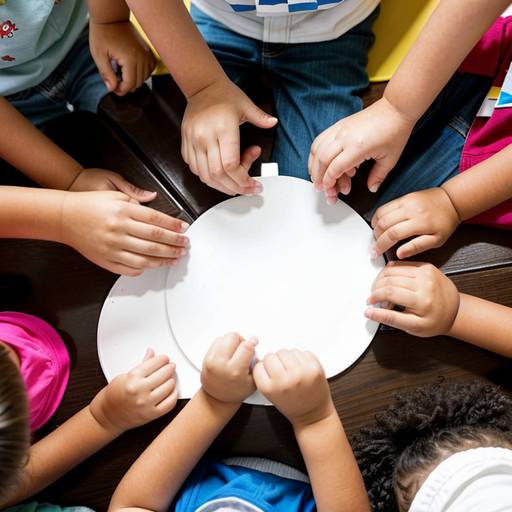
This Kindergarten math lesson focuses on introducing students to the concept of multiplication as repeated addition. It begins with a warm-up discussion about multiplication, followed by a read-aloud of a themed storybook that illustrates the concept. Through direct instruction, students learn to visualize multiplication with the help of counting blocks, making connections to addition.
In small groups, students participate in a hands-on activity where they represent different multiplication problems using blocks and share their findings with the class. This fosters teamwork and communication skills. After a collaborative presentation, students practice independently with worksheets that reinforce their understanding of multiplication through visual groupings. The lesson concludes with a reflective discussion about the importance and application of multiplication in real life.
Assessment is conducted through observation during group activities and the review of worksheets to ensure comprehension. Extensions and adaptations are available to further meet student needs and promote continuous learning. Overall, this lesson is designed to make multiplication engaging and accessible for young learners.

In this first-grade science lesson, students will explore the world of plants, focusing on their basic needs, structure, and growth processes. The lesson begins with an engaging discussion about plants, where students will learn key terms such as roots, stems, leaves, and flowers. Through group activities, students will observe and identify the parts of a potted plant, using drawing and labeling to reinforce their understanding.
Next, students will engage in a hands-on planting activity, where they will plant seeds in individual cups, while discussing the necessary conditions for growth. As they care for their plants, they will document their observations and actions on a growth chart. In the closure, students will reflect on their learning and share their discoveries about plants. Assessment will be based on participation, drawings, and a follow-up worksheet related to plant care. Additionally, students will create a Plant Growth Journal to track their plants' growth over time, fostering a deeper appreciation for nature and the environment.