
Filters
Level
Grade
Subject
Subject Area
Subject Topic
Standard(s)
Audience
Keyword
DurationMinutes
Elementary School Lesson Plans

In this fifth-grade math lesson focused on measurement and volume, students will explore the concept of volume through hands-on activities and practical applications. The objectives include understanding how to calculate the volume of rectangular prisms using the formula \( V = l \times w \times h \), as well as developing measuring skills with rulers and measuring tapes.
The lesson begins with a brief discussion of volume and its real-world relevance. Students will then learn how to measure the dimensions of a box and calculate its volume through guided practice. After measuring, students will fill their boxes with water or rice, allowing them to visualize and compare their calculated volume with the actual capacity.
As the lesson concludes, groups will share their findings and reflect on their experience. Assessment will be based on observation of group work, completion of worksheets, and journal reflections on what they learned. Extension activities may include exploring volumes of more complex shapes, while adaptations will be made to accommodate diverse learning needs. Overall, the lesson aims to impart a comprehensive understanding of volume through engaging, hands-on experiences.
This 4th-grade mathematics lesson focuses on teaching students about measurement and volume. The lesson begins with an introduction to the concept of volume, explaining how it differs from other types of measurements and introducing standard units such as cubic centimeters and liters.
Students receive direct instruction on calculating the volume of rectangular prisms using the formula for volume, followed by practical demonstrations on measuring volume through water displacement for irregular objects.
In a hands-on activity, students work in groups to measure and calculate the volume of various 3D objects using rulers and water, engaging them in collaborative learning. They also apply their understanding through real-life problem-solving scenarios presented on worksheets, which encourage them to think critically about volume in everyday contexts.
The lesson concludes with a review of key concepts and a discussion, allowing students to reflect on what they learned. Assessment includes evaluating students' worksheets for accuracy in calculations and observations of group dynamics during activities. This approach ensures that students comprehend the concept of volume through both theoretical knowledge and practical experience.

In this 5th-grade physical science lesson, students will explore the concepts of energy, motion, and waves through engaging hands-on activities. The lesson begins with a discussion about everyday examples of energy, followed by a video illustrating different types of energy in action. Students will work in small groups to conduct experiments, such as launching small balls with rubber bands and creating waves using strings and shallow trays of water.
Throughout these activities, students will make observations about how energy affects motion and how it travels in waves. After the exploration phase, the teacher will lead a discussion to clarify scientific concepts such as kinetic and potential energy, reinforcing students' understanding through their observations. To encourage critical thinking, students will reflect on the role of energy in their daily lives.
To evaluate comprehension, students will complete a worksheet that asks questions about their experiments and the principles of energy and waves they learned. The lesson concludes with ideas for follow-up activities, including a potential science fair where students can showcase their own energy-related experiments. By the end of the lesson, students will have a solid understanding of the fundamental principles of energy and motion in the physical world.

In this 1st-grade art lesson, students will explore basic watercolor painting techniques while creating their own vibrant ocean scenes. The lesson begins with a discussion about the colors and elements associated with the ocean, followed by a demonstration of watercolor techniques, including blending colors, creating textures with salt, and using plastic wrap for added effects. Students will then have the opportunity to apply these techniques in their artwork, focusing on creating a gradient effect in their paintings. After completing their artworks, students will engage in a gallery walk to showcase their creations and share their experiences. The lesson concludes with a reflection on their learning and a discussion about their artistic choices. Assessment will be based on their application of techniques and creativity in their final pieces. Extension activities may include writing a story about their scenes or exploring different painting mediums in future lessons.
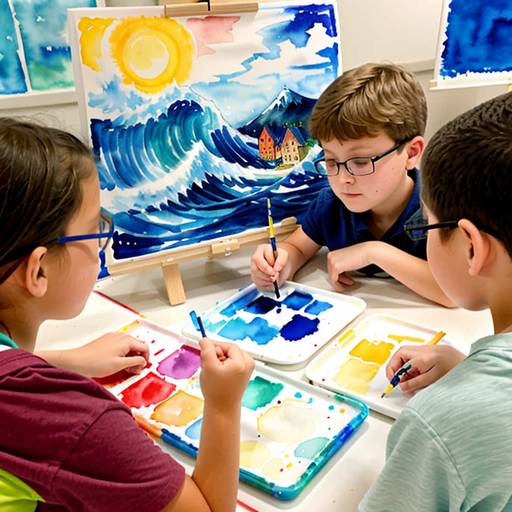
This 5th-grade art lesson focuses on exploring various watercolor techniques while encouraging creativity and self-expression. Over two class periods, students will learn and practice techniques such as wet-on-wet, wet-on-dry, and dry brush. By observing and discussing famous watercolor artworks, they will gain insight into the medium's history and applications.
In the first session, a demonstration will highlight each technique, followed by guided practice where students can experiment with colors and techniques on their own. After sharing their experiences in small groups, students will prepare to create their own final artwork.
In the second session, students will sketch their ideas and then paint their compositions using at least two techniques learned. After completing their artworks, a gallery walk will allow them to showcase their creations and provide feedback to peers. The lesson concludes with a reflection, discussing challenges faced and insights gained throughout the process.
Assessment will focus on their application of techniques and overall creativity, while optional extensions may include researching famous watercolor artists or collaborating on a class mural. The lesson aims to enhance students' artistic skills and foster a deeper appreciation for watercolor painting.
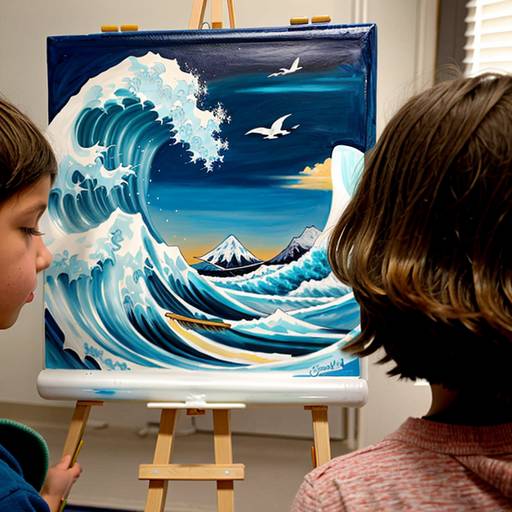
In this 3rd-grade art lesson, students will explore various painting techniques, including dry brush, wet-on-wet blending, and layering, through the creation of landscape artworks. The lesson begins with a discussion about different brush techniques and visual examples of landscapes, followed by a demonstration of each technique. Students will practice these techniques on scrap paper before applying them to their landscape paintings, focusing on elements such as the sky, land, and water. Throughout the process, they will be encouraged to experiment and use a combination of techniques.
At the end of the lesson, students will participate in a gallery walk to display their completed artworks, share their experiences, and reflect on what they learned about painting techniques. Assessment will be based on participation, the completion of their landscape paintings using multiple techniques, and engagement during reflections. Extensions will be available for early finishers, promoting further creativity. The lesson concludes with clean-up activities to encourage responsibility and collaboration.
In this 2nd-grade science lesson, students explore the concept of energy, specifically focusing on sound energy and how it is produced through vibrations. The lesson begins with a discussion to define energy, followed by an introduction to sound waves and their characteristics.
Students participate in hands-on activities where they experiment with rubber bands and containers to observe how vibrations create sound. They further explore sound production with various musical instruments and balloons, engaging with the concept of sound waves in a tangible way.
The lesson includes group discussions and individual drawings to reinforce their understanding of sound energy. To assess their learning, students share their observations and create artworks illustrating what they learned. Additionally, they are encouraged to explore sound concepts further at home. Overall, the lesson emphasizes inquiry-based learning and interaction with physical science principles through engaging activities.
In this 3rd-grade science lesson, students will explore sound as a form of energy that is created by vibrations. The lesson begins with a discussion to gauge prior knowledge about sound, followed by a demonstration using a tuning fork to illustrate how sound travels through vibrations.
Students will then participate in group activities that include experimenting with rubber bands to observe how tension affects pitch, using slinky toys to visualize sound waves, and exploring the production of sound by inflating and releasing balloons. After these hands-on activities, the class will regroup to discuss their findings, focusing on the characteristics of sound and vibrations.
To conclude, students will reflect on what they learned by drawing a picture of a sound they enjoy and describing how it is made. Assessment will include collecting their drawings and conducting a quick verbal quiz on the concepts covered. This engaging lesson emphasizes active learning and critical thinking, allowing students to better understand the relationship between sound, vibration, and energy.
In this 2nd-grade Earth Science lesson, students will explore various types of weather, including sunny, rainy, cloudy, and snowy. The lesson begins with engaging discussions about each weather type, allowing students to share their feelings and experiences related to them. Students will be introduced to basic weather instruments such as thermometers, rain gauges, and wind vanes, understanding their functions and importance.
During the activity, students will create weather journals, where they will draw their favorite type of weather and write a few sentences about how it makes them feel. The lesson concludes with a sharing session, allowing students to present their journal entries to the class, fostering a sense of community and reinforcing their understanding. Exit tickets will be collected to assess individual comprehension of the day's topics. Overall, this lesson aims to deepen students' understanding of weather and its impact on their daily lives while integrating art and writing skills.
In this 60-minute Earth Science lesson for 2nd graders, students will explore the four seasons and the various types of weather associated with each one. The session begins with an engaging introduction that activates prior knowledge through discussion and visuals, including a read-aloud from a picture book about seasons.
Students will learn about the distinct characteristics of spring, summer, fall, and winter, and how temperature affects weather patterns. A demonstration of a thermometer will help illustrate these concepts.
In groups, students will complete a seasonal weather chart by drawing and writing about the weather associated with each season, encouraging creativity and collaboration. They will also create seasonal weather mobiles using craft supplies to reinforce what they've learned visually.
The lesson concludes with a review of key points and a discussion on personal preferences for seasons and weather. Assessment will involve observing student participation and reviewing their charts and mobiles. Follow-up activities include maintaining a class weather journal to further encourage observation and connection to real-world weather phenomena.