
Filters
Level
Grade
Subject
Subject Area
Subject Topic
Standard(s)
Audience
Keyword
DurationMinutes
4th Grade Math Lesson Plans

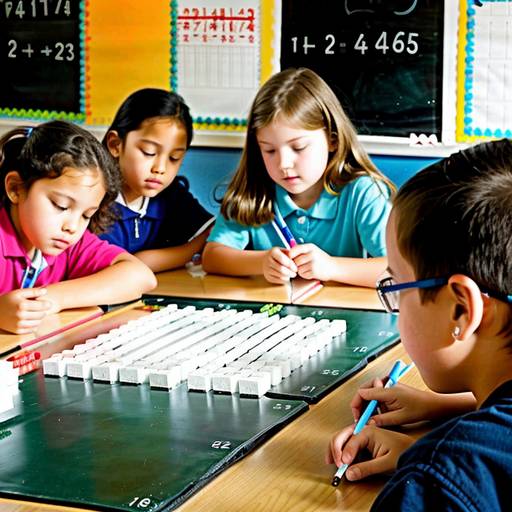
In this 4th-grade math lesson, students explore the concept of subtraction through interactive and collaborative activities. The lesson begins with a review of subtraction fundamentals, including the definitions of key terms and strategies for solving problems, such as using number lines and breaking apart numbers.
In a dynamic group activity, students participate in a relay race in which they work in teams to solve a series of subtraction problems located at different stations around the classroom. This hands-on approach promotes teamwork while reinforcing their understanding of both standard and regrouping subtraction.
After the group activity, students complete an independent worksheet featuring a mix of subtraction problems to further practice their skills. The lesson concludes with a review of strategies and sharing of experiences from the relay race. Assessment is conducted through observation and evaluation of worksheet accuracy, with tailored support provided for those who need additional assistance.
Overall, this lesson encourages student engagement and reinforces subtraction concepts through active learning, collaboration, and problem-solving.
In this 4th-grade mathematics lesson plan, students will focus on understanding and applying the concept of subtraction. The lesson begins with a warm-up activity that connects addition to subtraction through interactive questioning. Direct instruction follows, where various strategies for solving subtraction problems are introduced, including using a number line, counting back, and utilizing manipulatives like blocks or counters.
After the instructional phase, students will engage in guided practice, solving problems as a class while exploring different methods. They will then work independently on worksheets that feature both numerical and word problems that require subtraction skills. The teacher will circulate to provide assistance and assess students' understanding.
The lesson concludes with a review of the problems, encouraging students to share their challenges and strategies. To celebrate their participation and efforts, certificates will be awarded. Throughout the lesson, accommodations will be made for diverse learners, and reflection will take place post-lesson to identify successes and areas for improvement. This structured approach aims to foster a solid understanding of subtraction while promoting collaboration and motivation among students.
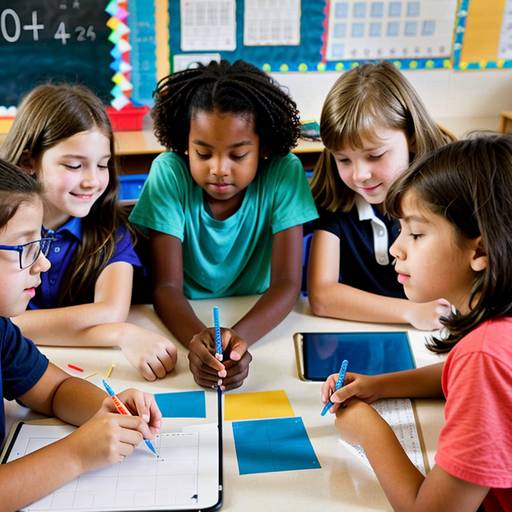
This 4th-grade math lesson focuses on teaching students the concept of subtraction through an engaging treasure hunt activity. Students will start with a story about pirates to pique interest and then review the principles of subtraction. The teacher will model several subtraction problems on the whiteboard, discussing strategies for solving them.
In small groups, students will receive maps with subtraction problems that they must solve to collect paper "treasure" tokens located around the classroom. Following the group activity, students will work independently on a subtraction worksheet to reinforce their skills.
The lesson concludes with a class review of the worksheet answers, where students will share their thought processes, fostering a collaborative learning environment. Teachers will assess understanding through observation during the activities and the completed worksheets, and opportunities for extension or support are also provided to accommodate different learning needs. Overall, the lesson aims to make subtraction interactive and enjoyable while promoting teamwork and critical thinking.

This lesson plan is designed for 4th-grade students to explore the concepts of geometry and symmetry. The objectives include defining symmetry, identifying symmetrical shapes and their lines of symmetry, and creating original symmetrical designs. The lesson begins with a discussion to introduce the idea of symmetry, followed by hands-on activities where students work in pairs to find lines of symmetry using mirrors and geometric cutouts. They will also design their own symmetrical shapes using construction paper and colored pencils. The session concludes with students sharing their creations and discussing the relevance of symmetry in art and nature. Assessment methods include observation during activities, evaluation of worksheets, and feedback on the students' designs. Extensions and differentiation strategies are provided to cater to varying learning needs and encourage deeper exploration of the topic.
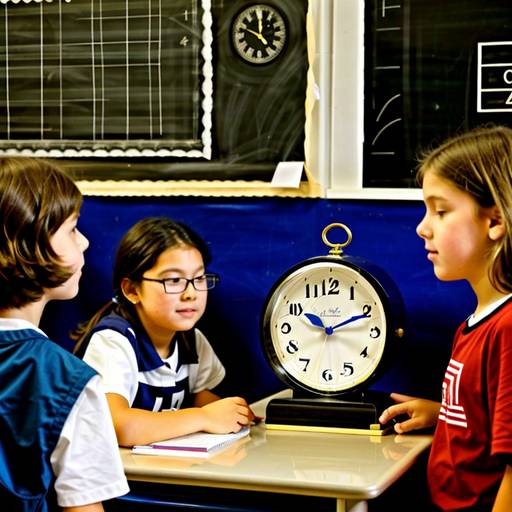
In this 4th-grade math lesson, students will explore the concepts of telling time and understanding time zones. The lesson begins with a discussion highlighting the importance of knowing the time, particularly when traveling and scheduling events. Students will review how to read both analog and digital clocks, followed by an introduction to time zones and how they are divided around the world, utilizing a world map for reference.
Through guided practice, students will engage in a matching activity that pairs cities with their respective time zones and calculate local times based on different starting points. They will also practice drawing times on blank clock faces.
For independent practice, students will complete worksheets featuring problems that require them to read clocks, convert time between zones, and solve word problems related to time and travel. The lesson concludes with a review of key concepts and an exit ticket that allows students to reflect on their learning. Assessment will be conducted through ongoing monitoring and the collection of worksheets to evaluate student understanding. Enrichment opportunities for advanced learners may include discussions on Daylight Saving Time and research projects on global time zones.
In this 4th-grade math lesson, students will explore the concepts of measurement and temperature. They will learn about temperature scales, specifically Celsius and Fahrenheit, and how to convert between the two using established formulas. The lesson begins with an engaging discussion on the significance of temperature in daily life, followed by direct instruction on temperature measurement techniques with thermometers.
Students will participate in guided practice by measuring classroom temperatures and converting readings between Celsius and Fahrenheit. They will then engage in an independent activity where they research the current temperature in a city of their choice, complete with conversions, and present their findings in a brief 'weather report' format.
Throughout the lesson, assessment will focus on participation, worksheet completion, and the accuracy of the presentations. Adaptations will be made for varying skill levels, ensuring that all students can grasp the key concepts of measurement and temperature, while also connecting their learning to real-world applications.
This lesson plan focuses on teaching 4th-grade students about measurement and temperature. The objectives are to help students understand temperature concepts and how to accurately measure it using thermometers in both Celsius and Fahrenheit. The lesson begins with a discussion on the significance of temperature in everyday life, followed by a demonstration on reading thermometers. Students then engage in a hands-on group activity where they measure the temperatures of various liquids, recording their findings. After the group activity, students individually complete worksheets that include temperature conversion and related word problems. The session concludes with a review of key concepts and an exit ticket to reinforce learning. Assessment methods include monitoring participation, reviewing worksheets, and evaluating group discussions. The lesson is designed to be inclusive and offers modifications for varying skill levels, along with extensions for further exploration of temperature measurement and weather tracking.
In this 4th-grade math lesson plan, students will focus on understanding time, specifically how to read both analog and digital clocks, as well as calculate elapsed time. The lesson begins with a class discussion to activate prior knowledge about time, followed by demonstrations on reading different clock formats. Students will receive direct instruction on calculating elapsed time through guided examples and will have the opportunity to practice in small groups using scenario cards that pose real-world time-related problems.
They will then engage in independent practice through worksheets designed to reinforce their skills in calculating elapsed time. The lesson concludes with a review of key concepts and a quick assessment to evaluate understanding. Additionally, students will be assigned homework to further solidify their learning. Extensions will be available for advanced students, providing them with more complex calculations involving multiple events. Through interactive activities and practical applications, this lesson aims to make the concept of time relatable and enjoyable for the students.

In this 4th-grade math lesson, students will explore the concept of addition through interactive and hands-on activities. The lesson begins with an introduction to addition, using a number line to illustrate the process with two-digit numbers while discussing its real-life applications. Following this, students will receive direct instruction on addition, including carrying over (regrouping), and will solve problems on small whiteboards in guided practice, allowing for collaboration with peers.
Next, students will work in small groups to tackle addition problems using manipulatives, fostering teamwork and showing their problem-solving strategies. Each group will present their solutions to the class, highlighting their methods and any challenges encountered. The lesson concludes with a recap of key concepts, prompting students to think about how they can use addition in everyday scenarios. Assessment will include observation during activities, checking worksheets for accuracy, and an exit ticket requiring students to demonstrate their understanding of addition. Accommodations and extensions will be provided to support varying skill levels and promote further practice.
In this 4th-grade math lesson centered around measurement and weight, students explore the concepts of length and weight through engaging activities. They begin with a discussion on the importance of measurement in everyday life, followed by a mini-lesson demonstrating how to use rulers and digital scales effectively. The class is then divided into groups to rotate through three hands-on stations: measuring various classroom objects for length, weighing items, and comparing their findings. After the station activities, the class gathers to share their discoveries. A "Mysterious Object" challenge encourages students to measure and weigh an unidentified item as a collaborative activity. The lesson concludes with a recap of key concepts and an assignment that invites students to practice measurement at home. Assessment is conducted through observation and review of completed worksheets, while differentiation strategies cater to diverse learning needs, ensuring an inclusive environment for all students.