
Filters
Level
Grade
Subject
Subject Area
Subject Topic
Standard(s)
Audience
Keyword
DurationMinutes
3rd Grade Math Lesson Plans


In this 3rd-grade math lesson, students will focus on understanding and solving word problems involving addition. The lesson begins with a warm-up activity that reviews basic addition facts using flashcards. The teacher will then model how to break down a sample word problem step-by-step, identifying key numbers, determining the operation needed, and visualizing the problem with counters.
Following the demonstration, students will participate in a group activity where they work in pairs to solve word problems together, reinforcing collaboration and problem-solving skills. They will then complete a worksheet with various addition word problems independently.
At the end of the lesson, there will be a class discussion where students share their solutions, enhancing their understanding through peer learning. An exit ticket will prompt students to reflect on what they learned during the lesson. Throughout the lesson, opportunities for differentiation will be provided to cater to varying student needs, ensuring all students can actively participate and succeed in solving addition word problems.

This comprehensive lesson plan for 3rd-grade mathematics focuses on teaching students the concept of addition and regrouping. The lesson begins with a warm-up activity to review basic addition facts and introduces the concept of regrouping through engaging questioning. Direct instruction utilizes visual aids such as base ten blocks and place value charts to illustrate how regrouping works, specifically through an example problem.
During guided practice, students collaborate in pairs to solve addition problems that incorporate regrouping, with ample teacher support available. Following this, students engage in independent practice by completing worksheets that include both standard addition problems and real-world word problems designed to apply the regrouping concept.
The lesson concludes with a review of key concepts, allowing students to reflect on what they learned and submit exit tickets highlighting one new concept and one lingering question. Throughout the lesson, the assessment methods include observation during group work, grading of independent worksheets, and analysis of exit tickets to gauge understanding and identify areas for further support. Overall, this lesson aims to foster confidence and competence in addition with regrouping in a supportive learning environment.

In this 60-minute lesson, 3rd-grade students will explore the concept of addition and regrouping through engaging activities and hands-on practice. The lesson begins with a relatable scenario to capture students' attention and introduce the need for addition.
The teacher will model the process of addition on the whiteboard, focusing specifically on regrouping when the sum exceeds ten. Students will use place value charts and base-ten blocks for a visual demonstration of the concepts. After direct instruction, students will work in pairs to solve a series of addition problems, using manipulatives to reinforce their understanding of regrouping.
Following guided practice, students will complete a worksheet featuring a mix of addition problems, including those that require regrouping. They will also participate in a fun relay game, solving addition problems from cards for extra practice and a competitive element.
The lesson will conclude with a review of key concepts, and students will complete an exit ticket to assess their understanding. Throughout the lesson, the teacher will monitor progress, providing support as needed and adjusting future instruction based on student performance and comprehension. Adaptations will be made for advanced learners and those needing additional assistance to ensure everyone can grasp the concepts effectively.

In this 3rd-grade math lesson, students will explore the concept of addition with regrouping. The objective is for them to grasp the regrouping process through hands-on activities and direct instruction. The lesson begins with an engaging introduction, where students relate addition to their personal experiences. A demonstration using base ten blocks will illustrate the regrouping method with a two-digit addition problem, allowing students to visualize the concept.
Following the demonstration, students will participate in a guided group activity where they will work together to solve addition problems while utilizing manipulatives. This collaborative practice encourages discussion and reinforces understanding. After that, students will complete a worksheet independently, applying the regrouping strategy to various addition problems.
The lesson concludes with a review of the concepts covered, where students will share their strategies and clarify their understanding. As an exit ticket, they will write down their own addition problem with regrouping to reinforce learning. Assessment will be based on participation during activities, worksheet accuracy, and exit ticket responses. Differentiation strategies will be employed to support both struggling and advanced learners, while extensions may include technology tools or a math scavenger hunt to further engage students. Overall, the lesson aims to build students' confidence in addition through interactive and practical learning experiences.

In this 3rd-grade math lesson, students will explore the concept of addition through the lens of word problems. The lesson begins with a storytelling hook that introduces the theme of exploration and problem-solving. Students will learn to identify key components in word problems, such as important numbers and keywords that indicate addition. Through modeling, they will practice breaking down sample problems and setting up number sentences.
Following direct instruction, students will engage in guided group activities, where they will work collaboratively to solve different addition word problems, discuss their solutions, and present their methods to the class. This encourages teamwork and allows them to learn from each other.
For independent practice, students will complete a worksheet with a variety of addition word problems, reinforcing their understanding through individual work. The lesson concludes with a reflection where students share their experiences and favorite problems, promoting a deeper engagement with the material.
Throughout the lesson, assessment will be based on worksheet answers and group discussions, guiding further instruction as necessary. Extension activities will challenge students to create their own word problems, fostering creativity and consolidation of their understanding of addition.
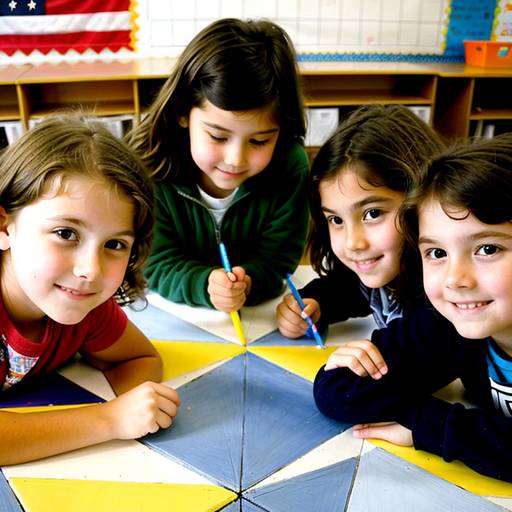
In this 3rd-grade math lesson, students will learn about geometry and angles by identifying and classifying different types of angles: acute, right, and obtuse. The lesson begins with an introduction discussing the concept of angles in real-life objects, followed by a direct instruction segment where the teacher demonstrates how to use a protractor to measure angles in various shapes.
During guided practice, students will engage with angle worksheets to measure and classify angles, collaborating with a partner to discuss their findings. The hands-on activity involves a scavenger hunt where small groups explore cardboard shapes to identify and chart angles. Each group will then present their discoveries to the class, reinforcing their understanding of the material.
The lesson concludes with a recap of key concepts and a homework assignment encouraging students to find and photograph objects with different angles in their home environment. Assessment will be based on student participation, accuracy in worksheet completion, and the quality of group presentations. Differentiation strategies are included to support diverse learning needs within the classroom. Overall, the lesson combines exploration, collaboration, and real-world connections to make the study of angles engaging and meaningful.
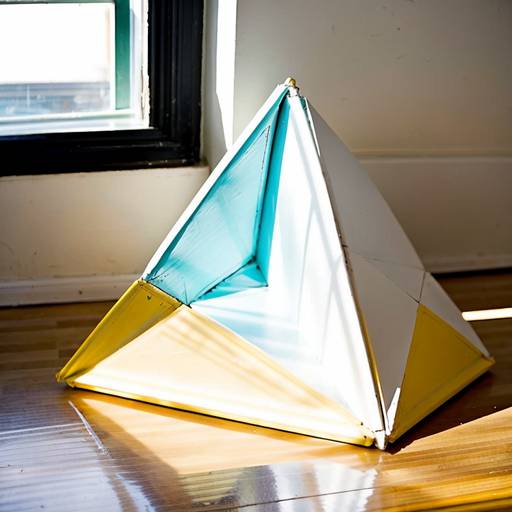
In this engaging 60-minute math lesson for third graders, students will explore the concept of angles and their classifications, including acute, right, and obtuse angles. The lesson begins with a discussion and visual identification of angles in the classroom, emphasizing their significance in everyday life.
Following this introduction, students will learn how to measure angles using protractors through direct instruction, complete with the aid of angle flashcards for visual reinforcement. In a guided practice activity, students will work in small groups to find and measure different angles in their environment, sharing their discoveries with the class.
For independent practice, students will create unique shapes using colored paper, ensuring they include at least one of each angle type and labeling them accordingly. The lesson wraps up with a gallery walk, allowing students to showcase their creations and identify angles in their classmates' work.
Assessment will occur through the evaluation of their angle hunt worksheets and observation during the creative activity. This interactive lesson not only promotes understanding of angles but also fosters collaboration and creativity among students.
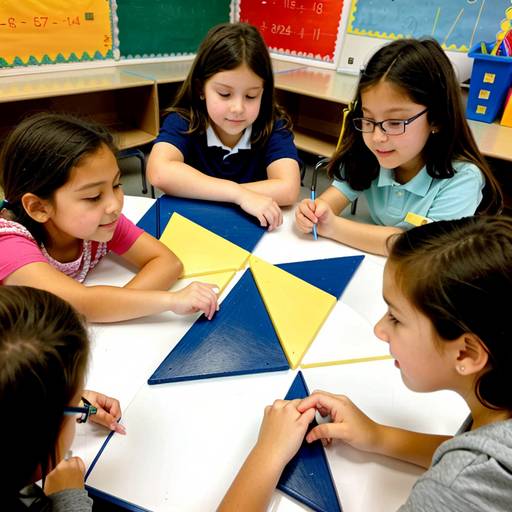
In this engaging 3rd-grade math lesson, students will explore the concepts of geometry and angles, focusing on identifying and measuring different types of angles: acute, right, and obtuse. The lesson commences with a discussion to build background knowledge about angles found in everyday life, followed by a clear introduction of the three angle types.
Students will receive direct instruction on using a protractor to measure angles accurately, which will be practiced through angle worksheets that require them to classify the angles they measure. Following guided practice in pairs, students will create a unique art project using various angles, fostering creativity and application of the geometry concepts learned.
The lesson concludes with students sharing their artwork, explaining the types of angles incorporated in their designs. Assessment is based on their angle worksheets and art projects, ensuring a comprehensive evaluation of their understanding. Adaptations and extensions are provided to support diverse learning needs and maintain engagement. Overall, this lesson combines theoretical knowledge with hands-on activities to solidify students' understanding of geometry and angles.
In this 3rd-grade math lesson, students will explore the concepts of time and time zones through a combination of engaging activities and discussions. They will learn to read both analog and digital clocks and understand how time zones are established due to the Earth's rotation. Using a world map, students will identify various time zones and match them with major cities.
The lesson includes a matching game where small groups will collaborate to connect cities with their corresponding time zones. Students will also practice calculating time differences based on various scenarios provided in a worksheet, enhancing their problem-solving skills.
By the end of the lesson, students will have a better understanding of how time varies across different regions of the world and why this knowledge is important for communication and travel. The lesson concludes with a reflection on the significance of time zones and encourages students to consider connections they may have with people in different parts of the globe. Extensions may include research on a selected country or city’s local time. Overall, this lesson aims to foster both mathematical skills and global awareness.
This lesson plan focuses on teaching 3rd-grade students the concepts of multiplication and arrays. The objectives include helping students understand multiplication as repeated addition, creating and recognizing arrays as visual representations, and solving simple multiplication problems.
The lesson begins with an engaging question to prompt discussion about multiplication, followed by a definition and explanation of arrays. Students will then work in small groups to create their own arrays using counters for various multiplication problems. After sharing their creations with the class, students will complete a worksheet that requires them to draw and label arrays for specific multiplication problems.
The session concludes with a review of the key concepts and an exit ticket activity, where students write a multiplication problem and draw a corresponding array. Assessment will be based on student participation, the accuracy of their array drawings, and responses to the exit ticket. The lesson incorporates opportunities for differentiation and extensions to accommodate varying student needs and abilities.