
Filters
Level
Grade
Subject
Subject Area
Subject Topic
Standard(s)
Audience
Keyword
DurationMinutes
5th Grade Lesson Plans

In this 60-minute lesson, 5th-grade students will explore the key elements of narrative writing, including characters, setting, plot, conflict, and resolution. The session begins with a discussion about what makes stories interesting, which will be recorded on a whiteboard. After introducing the key narrative elements with examples, students will engage in guided practice by working in small groups to create a story map based on a familiar tale. Each group will present their story map to the class, reinforcing their understanding of narrative structure.
Following this collaborative activity, students will brainstorm and outline their own narrative ideas using provided prompts, focusing on developing their main character, setting, conflict, and resolution. They will then draft their narratives, incorporating descriptive language and dialogue. The lesson concludes with students sharing portions of their stories with the class, helping to foster a sense of community and encouraging creativity.
Assessment will be carried out by collecting outlines and narrative drafts to evaluate students' comprehension of narrative structure and their writing skills. Extensions and differentiation strategies are included to cater to varied learning needs, ensuring all students can engage meaningfully with the writing process.

This 5th-grade math lesson focuses on enhancing students' understanding and application of addition through engaging activities. Students will explore concepts of multi-digit addition, including strategies such as regrouping and breaking down numbers. The lesson begins with a discussion about the importance of addition in everyday life, followed by direct instruction where the teacher demonstrates various addition techniques.
In guided practice, students work in pairs to solve addition flashcards in a timed challenge, promoting collaboration and interactive learning. They then transition to independent practice, completing worksheets that reinforce their skills. The lesson concludes with a review of key concepts and strategies, giving students the opportunity to share their experiences. To motivate and celebrate progress, small prizes are awarded for participation and accuracy.
Throughout the lesson, differentiation strategies are employed to accommodate diverse learning needs, ensuring that all students can engage with the material effectively. Extension activities encourage further practice and application of addition skills outside the classroom. Overall, the lesson aims to create an engaging and supportive environment that fosters a positive attitude towards math.
The lesson plan for 5th-grade students focuses on exploring geometry, specifically angles. It aims to help students define and identify three main types of angles: acute, right, and obtuse. Throughout the 60-minute session, students will engage in discussions about where angles can be found in everyday life, followed by direct instruction on how to measure angles using a protractor.
Guided practice will involve students measuring and classifying angles on worksheets while collaborating in pairs. The lesson incorporates a real-world application through an "Angle Scavenger Hunt," where students search for objects demonstrating the various types of angles in the classroom or school environment.
The class will conclude with a reflection on the learning experience, encouraging students to share their discoveries. Assessment will be based on participation during activities and accuracy in measuring angles. The lesson also includes potential extensions for advanced learners and differentiation strategies to support all students, ensuring a comprehensive understanding of angles in geometry.
In this 5th-grade math lesson, students will explore the concepts of angles and their classifications within geometric shapes. The lesson begins with an engaging activity where students identify angles in their surroundings and learn to differentiate between acute, right, obtuse, and straight angles. Instruction follows, focusing on how to accurately use a protractor to measure angles, complemented by a class activity that allows students to practice measuring angles on a whiteboard.
After guided practice, students will receive worksheets to identify and measure angles independently. They will also engage in a creative activity where they construct geometric shapes featuring various angles, which they will then measure and classify. The lesson concludes with a review of key concepts and an exit ticket exercise where students reflect on their learning.
Assessment will be conducted through observations and the evaluation of worksheets and exit tickets. Extensions will be offered for advanced students, while additional support will be available for those who need it. Overall, this lesson aims to strengthen students’ understanding of angles and their significance in geometry through interactive and practical experiences.
This lesson focuses on teaching 5th-grade students about geometry and area by exploring various 2D shapes such as squares, rectangles, triangles, and parallelograms. Students will learn to identify these shapes and use appropriate formulas to calculate their areas, with applications to real-life scenarios. The lesson includes direct instruction on area formulas, guided group practice with shape calculations, and independent practice through a worksheet.
To reinforce understanding, students will creatively design their own parks using different geometric shapes while calculating their respective areas. The lesson concludes with a group reflection on the importance of area in everyday contexts. Assessment will include observations during collaborative activities, completed worksheets, and evaluations of park designs. Extensions and modifications are provided to accommodate varying skill levels. Finally, students will be assigned homework to apply their knowledge at home by calculating the area of an object or space in their environment.
In this 5th-grade mathematics lesson, students will explore the concept of time and time zones. The session begins with a discussion about time zones and their significance, followed by an explanation of local time versus world time. Using a world map, students will learn about different time zones and how to calculate time differences between various locations, particularly comparing Eastern Standard Time with other zones.
During guided practice, students will complete worksheets that involve calculating the time in different cities based on specific scenarios. This will be followed by independent practice, where they will choose a city, determine its time zone, and create a visual representation of the time differences compared to their local time.
The lesson concludes with a recap of the key concepts, and students will share their findings about the chosen cities. Assessment will take place through the collection of worksheets and independent assignments to evaluate understanding. Extensions and modifications are provided to accommodate different learning needs and to encourage deeper exploration of related topics, such as Daylight Saving Time. Overall, students will gain a better grasp of global timekeeping and its relevance in today’s interconnected world.

In this 5th-grade social studies lesson, students will explore the concept of community and the diversity present within it. The lesson begins with a class discussion to define community and discuss its various elements, emphasizing the importance of diversity. Students will then work in small groups to research cultures from different continents, creating informative posters that highlight aspects such as flags, traditional clothing, food, and cultural practices. Each group will present their findings to the class, fostering engagement and encouraging questions.
Next, the classroom transforms into a culture fair, where students can visit each group's station and fill out a "Culture Passport" with interesting facts learned from their peers. Optional guest speakers from local cultural communities may also be invited to enhance the learning experience. The lesson concludes with reflective writing and a class discussion on the importance of understanding and celebrating diversity in building a strong community. Assessments will focus on group participation, the quality of the posters, and insights shared in the cultural passports. Extensions and adaptations are provided to cater to the diverse needs of learners and to deepen their engagement with the topic.


In this 5th-grade art lesson plan, students will embark on an exploration of art history, focusing on famous artists and their contributions to various art movements. The lesson is divided into two class periods. In the first session, students will engage in a discussion about the significance of art, followed by a presentation that introduces several renowned artists and their defining styles and movements. After the presentation, students will work in small groups to research specific art movements and the artists associated with them.
In the second session, students will select an artist that inspired them and create their own artwork using techniques and styles reminiscent of that artist. This hands-on activity will encourage creativity and personal expression. As a culmination of the lesson, students will share their artwork with the class, discussing how their chosen artist influenced their creation. Assessment will focus on participation, the research worksheet, and the quality of the artwork presented. Extension activities may include creating artist trading cards or organizing a field trip to a local art museum, enhancing students' appreciation of the artists they studied.
This lesson plan for 5th-grade students focuses on exploring art history and various art movements through a two-day activity. In the first class, students engage in discussions about what makes art significant and are introduced to key art movements such as Impressionism, Cubism, Surrealism, and Abstract Art. Working in small groups, they create posters that highlight the characteristics, notable artists, and historical context of their assigned movement, which they then present to the class.
On the second day, students use their learned knowledge to create their own original artwork inspired by their favorite movement. They have the freedom to choose from a variety of materials and techniques, allowing them to express their interpretations creatively. After completing their artwork, students participate in a gallery walk where they display their pieces and explain the influence of the selected art movement on their creations. The assessment focuses on participation, creativity, and the ability to articulate their artistic choices. Extensions include reflective writing on their learning experience and the option to explore digital art tools. The lesson encourages collaboration, creative expression, and a deeper understanding of how art reflects historical and cultural contexts.
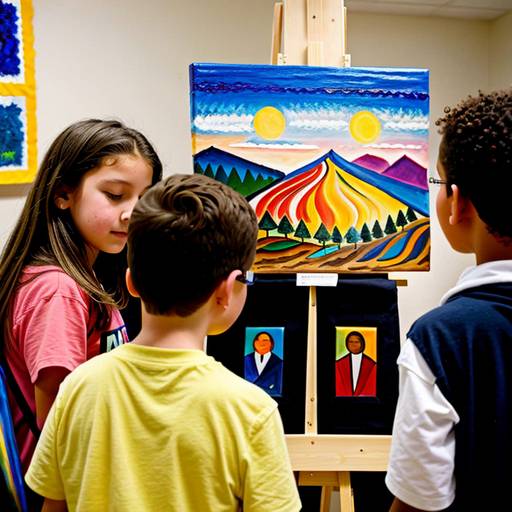
In this 5th-grade art lesson, students will explore the evolution of art through various historical movements, gaining insights into the cultural contexts that shaped them. The lesson begins with an engaging discussion about the meaning of art, followed by a presentation showcasing major art movements such as Impressionism, Cubism, and Surrealism. Students will examine key characteristics of these movements and observe how they differ from one another.
Following the presentation, students will select one movement that intrigues them and create their own artwork inspired by its distinctive elements. Utilizing various art materials, they will have the opportunity to express their creativity while incorporating features from their chosen movement. After completing their projects, students will participate in a gallery walk to display their work, exchange positive feedback, and appreciate each other's artistic expressions.
The lesson concludes with a discussion, allowing students to share their artistic inspirations and reflect on the importance of understanding art history. Assessment will be based on participation, creativity in their artwork, and engagement during the gallery walk. Optional extensions include a homework assignment for further exploration of additional art movements and a potential class art show to celebrate their creations.