
Filters
Level
Grade
Subject
Subject Area
Subject Topic
Standard(s)
Audience
Keyword
DurationMinutes
Elementary School Lesson Plans


In this 2nd-grade math lesson, students will explore the concepts of fractions, focusing on understanding halves (1/2) and quarters (1/4). The lesson begins with a discussion about fractions and includes engaging elements, such as a catchy song to capture students' interest. Using visual aids, students will learn how to divide shapes and objects into equal parts.
Hands-on activities will involve students cutting paper plates into halves and quarters, allowing them to see and label these fractions visually. Following this, they will complete worksheets that require them to color specific fractions of images, reinforcing their understanding through independent practice.
The lesson concludes with a class discussion to review key concepts and encourage students to share their creations. Assessment will be conducted through observation during activities, evaluation of worksheet completion, and an exit ticket to gauge comprehension of the material. Extensions and supports will be provided to cater to diverse learning needs within the classroom.

This 4th-grade math lesson focuses on helping students understand fractions as parts of a whole and applying this knowledge to solve real-world word problems. The lesson begins with a review of fractions and an introduction to fractional word problems through engaging class discussions. Students participate in guided practice as they collaboratively solve sample problems using visual aids like fraction circles.
They then move on to independent practice with worksheets featuring a variety of fraction word problems, giving them an opportunity to apply their learning. The lesson concludes with a sharing session where students present their solutions, thereby reinforcing their understanding through peer interaction. Assessment is based on participation and accuracy in solving problems, with follow-up activities available for early finishers. Overall, the lesson aims to enhance students' comprehension of fractions and their practical applications through interactive and collaborative learning experiences.
This 4th-grade math lesson focuses on teaching students about fractions and how to compare them effectively. The lesson begins with an engaging discussion to introduce the concept of fractions as parts of a whole, using real-life examples. Students will learn to compare fractions through direct instruction involving visual models, such as fraction circles, and methods for finding common denominators.
During guided practice, students will work in pairs to create and compare their own fractions using hands-on materials and write their comparisons using symbols (<, >, =). Following this collaborative activity, students will complete a worksheet that reinforces their understanding by requiring them to visualize and compare fractions both numerically and on a number line.
The lesson concludes with a class recap where students share their findings and reflect on the concepts learned. Assessment will be based on observation during activities and evaluation of the completed worksheets, with accommodations provided for different learning needs. The overall goal is to ensure students grasp the foundational skills related to fractions and can confidently compare them in various contexts.
In this 5th-grade math lesson focused on subtracting fractions, students will explore concepts related to fractions, including numerators and denominators. The lesson begins with a review of fractions in real-life contexts, followed by direct instruction on subtracting fractions with like and unlike denominators. Students will learn to find common denominators when necessary and be introduced to the importance of simplifying their answers.
During guided practice, students will work in small groups to visually illustrate the process of subtracting fractions using fraction strips or models. A worksheet will be provided for students to practice subtraction problems, including examples requiring simplification.
To reinforce their learning, students will create fraction posters that summarize the key concepts, definitions, and subtraction methods learned in class. The lesson concludes with a recapitulation of the day’s key points and homework assignments focused on reinforcing their understanding. Differentiation strategies will be employed to meet the varying needs of students, ensuring that all learners engage with the material appropriately. The overall goal is to cultivate a solid understanding of fraction subtraction and its applications.
In this 5th-grade mathematics lesson, students will explore the concept of fractions with a focus on adding fractions with both like and unlike denominators. The lesson begins with a review of fractions using visual aids to illustrate how they represent parts of a whole. Direct instruction involves explaining the process of adding fractions with like denominators by keeping the denominator the same and summing the numerators. The instructor then introduces the concept of finding a common denominator for adding fractions with unlike denominators, demonstrating how to convert the fractions and sum them effectively.
During guided practice, students will work on worksheet problems collaboratively, with opportunities to share their solutions on the whiteboard. They will then engage in independent practice to reinforce their understanding. The lesson concludes with a group discussion to review answers and strategies, along with a quick exit ticket assessment to gauge individual comprehension.
Extensions are provided for advanced learners, including word problems involving real-life scenarios with fractions, while reflection on the lesson's effectiveness will help inform future instruction. Overall, this lesson integrates visual learning, hands-on activities, and collaboration to engage students in understanding the addition of fractions.

This 60-minute math lesson for 2nd-grade students focuses on introducing the concept of fractions as parts of a whole. The lesson begins with a discussion on fractions and their relevance in everyday life, followed by a demonstration using paper plates to visually represent fractions like 1/2, 1/3, and 1/4. Students engage in a hands-on activity where they cut their own plates into different fractions and decorate them, which they then share with a partner, explaining their creations.
During the independent practice segment, students complete worksheets that reinforce their understanding of identifying and creating fractions. The lesson concludes with a review, where students share what they learned. Assessment is conducted through observation of participation and collection of worksheets. Extensions and modifications are included to accommodate different skill levels, ensuring an inclusive learning environment. Overall, this lesson is designed to make fractions accessible and engaging for young learners.
This lesson plan focuses on introducing 2nd-grade students to the concept of fractions as parts of a whole through an engaging, hands-on activity. The lesson begins with a discussion about sharing pizza, which serves as a relatable context for understanding fractions. Students learn vocabulary related to fractions, such as whole, half, quarter, and eighth, and practice dividing paper plates into these fractions.
During guided practice, students cut and label their plates to visually represent different fractions, reinforcing their understanding. Independent practice involves worksheets where students further explore fractions by dividing shapes and identifying shaded areas. The lesson concludes with a group discussion, allowing students to share their creations and apply their knowledge to real-life situations. Assessment is based on observation during activities and the accuracy of completed worksheets, with opportunities for differentiation provided for those who progress quickly. Overall, the plan fosters a practical understanding of fractions while encouraging creativity and collaboration among students.

This 5th-grade math lesson focuses on understanding and subtracting fractions, specifically fractions with like denominators. The lesson begins with a review of fractions, including the roles of numerators and denominators, using visual aids like pizza slices for clarification. The instructor then introduces the concept of subtracting fractions with the same denominator, providing clear examples and demonstrating the simplification of results.
Students engage in guided practice using fraction manipulatives and complete worksheets with subtraction problems. They also tackle word problems that require them to apply their understanding of fraction subtraction independently. The lesson concludes with a review of key concepts, allowing for feedback and reinforcement.
Assessment is conducted through the collection of worksheets and observations during activities, ensuring that students grasp the content. Accommodations are in place for those needing extra support, while advanced learners can be challenged with problems involving unlike denominators. Overall, this lesson aims to build foundational skills in subtracting fractions through hands-on activities and collaborative learning.
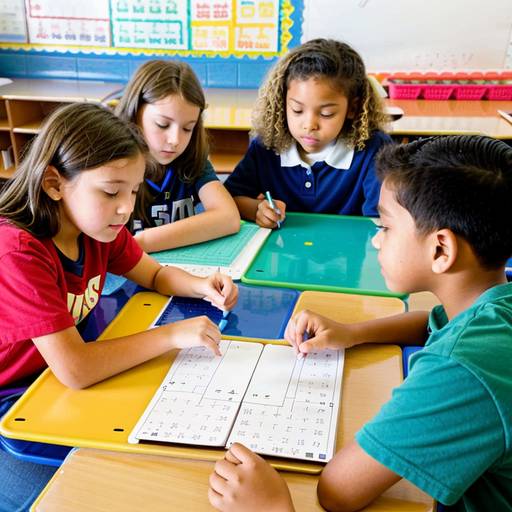
This lesson plan is designed for a 5th-grade math class focusing on fractions and solving word problems. The objectives include understanding fractions, representing them visually, and practicing addition and subtraction of fractions with like denominators. The lesson begins with a review of fractions using real-world examples to engage students. Direct instruction involves presenting various fraction word problems, explaining step-by-step solutions, and utilizing fraction models to aid comprehension.
During guided practice, students work in pairs to solve similar problems, fostering collaboration and discussion. They then complete independent practice with more challenging word problems. The lesson concludes with a review of answers as a class, encouraging students to share their strategies and reflections on the importance of fractions in everyday life. Assessment is conducted through collected worksheets and observations during group activities, with extensions available for advanced students. Overall, the plan emphasizes interactive learning and the practical application of mathematical concepts.
This lesson plan for 5th-grade students focuses on the concept of adding fractions, particularly targeting fractions with like denominators. The lesson begins with a review of fractions, where students share real-life examples and learn key vocabulary terms. Direct instruction follows, demonstrating how to add fractions using visual aids, such as fraction strips. Students then engage in guided practice where they solve problems collaboratively, reinforcing their understanding of the addition process.
For a hands-on activity, students create their own fraction strips using colored pencils, allowing them to visually represent and add fractions creatively. The lesson concludes with a review of key concepts and an exit ticket that assesses their understanding through practical application problems. Adaptations are included to support diverse learners, ensuring that advanced students are challenged with problems involving unlike denominators while additional support is provided for those who may struggle with the material. Overall, the plan emphasizes interactive learning and practical application to help students master the addition of fractions.