
Filters
Level
Grade
Subject
Subject Area
Subject Topic
Standard(s)
Audience
Keyword
DurationMinutes
Lesson Plans

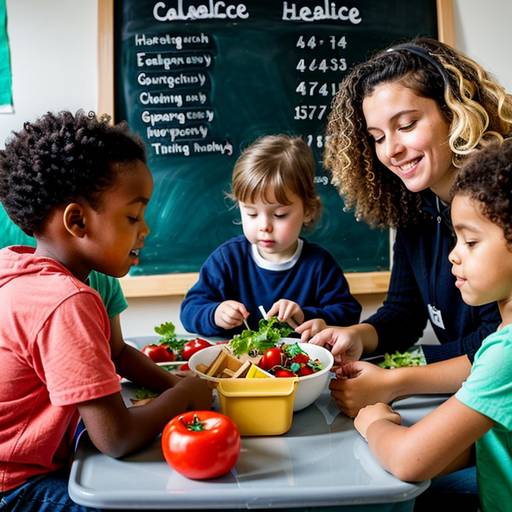
In this preschool lesson, students will engage in an interactive exploration of health and nutrition by learning about the different food groups and the importance of making healthy eating choices. The session will begin with a discussion on healthy foods, allowing children to share their favorites. They will participate in a hands-on activity where they classify various food pictures into appropriate categories, such as fruits, vegetables, grains, proteins, and sweets/junk food.
Following this, students will use craft materials to create their own "Healthy Plate," illustrating a balanced meal with their chosen foods. The lesson will conclude with a review, where children share healthy foods they enjoy or want to try, promoting dialogue about nutrition at home. Through participation, creativity, and collaboration, students will gain a foundational understanding of healthy eating habits and the benefits of nutritious foods. Potential extensions include family activities, visits to local food markets, and special snack days to further encourage healthy eating practices.

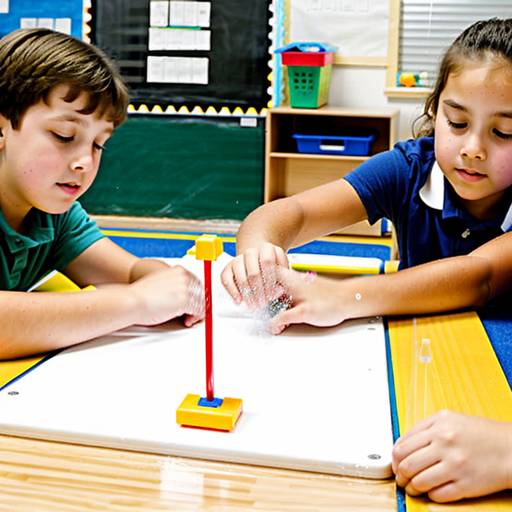
In this 4th-grade science lesson, students will explore fundamental concepts of forces, specifically focusing on pushes, pulls, and the role of friction. The lesson begins with an engaging discussion to elicit student experiences related to motion and forces. Following this, key terms and concepts will be introduced, including friction's impact on the movement of objects.
Students will then participate in a hands-on experiment where they will test how various textured surfaces affect the speed of toy cars. Working in small groups, they will measure the time it takes for the cars to travel a certain distance on different surfaces and record their observations. This activity fosters teamwork and enhances understanding through practical application.
After the experiment, students will regroup to discuss their findings, providing insights into how friction influences motion. To conclude, they will reflect on their learning and pose any remaining questions on an exit slip. The lesson emphasizes interactive learning and critical thinking, helping students grasp essential physical science principles while making real-world connections. Adaptations and extensions are provided to support diverse learners and encourage further exploration of related concepts.
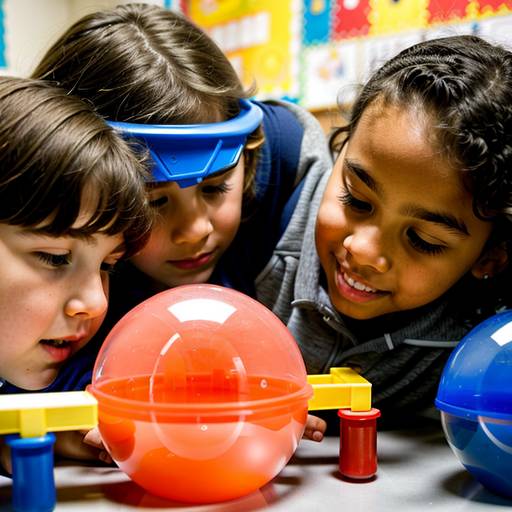
This 3rd-grade science lesson focuses on the concepts of pushes and pulls as fundamental forces. The lesson begins with an engaging introduction to the definitions of these forces and their roles in everyday life, prompting students to share their experiences. Following direct instruction that includes visuals highlighting different forces, students are divided into small groups to conduct a hands-on experiment with toy cars and ramps. They test the effects of pushing and pulling the cars, both with and without added weights, while recording their observations. The class then reconvenes to discuss each group's findings and insights about the ease of pushing versus pulling. To conclude the lesson, students complete a worksheet summarizing their learning, which serves as an assessment of their understanding. The lesson allows students to grasp the practical implications of forces in their daily lives, setting a solid foundation for future exploration in physical science.
In this 5th-grade science lesson, students will explore fundamental concepts of physical science, focusing on forces and motion. The lesson begins with an engaging video showcasing various forces in everyday life, followed by a class discussion where students share their observations of forces in action. Key concepts such as gravity, friction, and the distinction between push and pull are introduced with visual aids.
Students will then participate in a hands-on experiment where they work in small groups to investigate how adding weight affects the distance a toy car travels down a ramp. They will set up their ramps, conduct trials, record data, and analyze their results. Afterward, groups will share their findings with the class, discussing the implications of their experiments and how different forces impacted their outcomes.
The lesson encourages collaboration and critical thinking, as students reflect in their science journals on their experiments and learn how understanding forces influences their daily lives. Extensions for advanced learners are included to deepen their understanding of balanced and unbalanced forces, along with a homework assignment that reinforces real-world applications of the concepts learned. Overall, this lesson fosters a hands-on, inquiry-based approach to learning about forces in physical science.
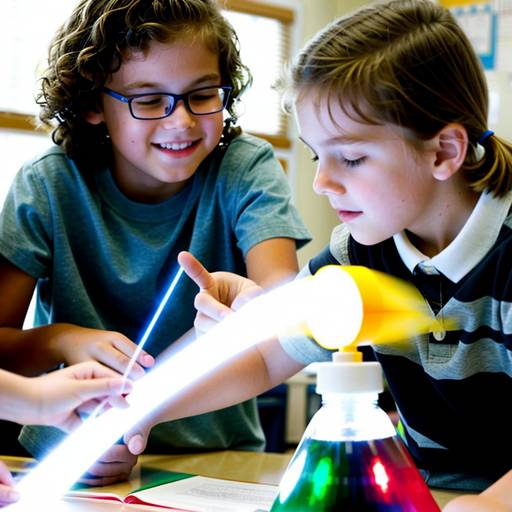
In this 4th-grade science lesson, students will explore the concepts of forces and motion, specifically focusing on push and pull. The lesson begins with an engaging discussion about the movement of objects in their environment, followed by a clear explanation of different types of forces and their effects, including the role of friction.
Students will participate in a hands-on experiment where they will work in small groups to test how different forces influence the distance that a small ball or toy car travels down a ramp. By adjusting the angle of the ramp and adding weights, they will observe and record their results, which will promote understanding of the relationship between force and motion.
The lesson culminates in a class discussion where students share their findings and reflect on their learning. Through this interactive approach, they will develop a foundational understanding of physical forces and their implications in everyday situations, while also honing their data collection and analytical skills. Assessment will be based on observation during activities, worksheet completion, and participation in discussions. Extensions are provided for students who wish to explore further challenges related to forces and motion.


This lesson plan is designed for a group of infants and their caregivers, focusing on fostering bonding through interactive and engaging activities. The session begins with a warm welcome, followed by a tummy time activity that promotes motor skills while encouraging proximity and support from parents.
Caregivers and infants will then participate in playful games such as Peek-a-Boo and "Where’s Baby?" to enhance social interaction and create positive emotional responses. Sensory exploration stations featuring varied textures and sounds will further strengthen communication and bonding, allowing infants to engage with their surroundings in a safe environment.
A music and movement segment encourages parents to sway with their babies while enjoying soft tunes, reinforcing the nurturing connection between them. The session concludes with a group reflection, where parents can share their experiences and insights about the activities. Handouts with additional bonding techniques will be provided for continued practice at home. Overall, this lesson aims to enhance emotional connections and develop essential social skills during early infant development.

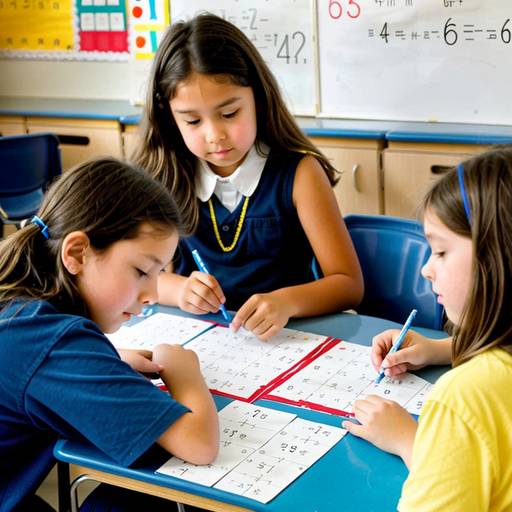
In this 4th-grade math lesson, students will focus on understanding and subtracting fractions with like denominators. The session begins with a brief review of fractions, including their components and visual representations using fraction circles. Students will learn the process of subtracting fractions through direct instruction and guided practice involving visual aids. After working collaboratively on a worksheet, they will have the opportunity to engage in a hands-on activity using real-world objects, such as pizza slices or fruit pieces, to act out fraction subtraction problems. The lesson concludes with a recap of the key concepts, followed by individual assessments through completed worksheets. To accommodate different learning needs, the lesson includes extensions for advanced learners and additional support for those who require it. Overall, this lesson aims to provide an interactive and practical approach to mastering the subtraction of fractions.
This math lesson plan for 5th-grade students focuses on introducing and practicing the concept of dividing fractions. The lesson aims to enhance students' understanding of fractions and demonstrate how to apply the "Keep, Change, Flip" method when dividing one fraction by another.
The session begins with a review of fractions and their importance in everyday life, followed by direct instruction where the method is explained and demonstrated through example problems on the whiteboard. Students then engage in guided practice, collaboratively solving additional fraction division problems.
For independent practice, students complete worksheets featuring a range of fraction division problems, including word problems that encourage critical thinking. The lesson concludes with a review of key concepts, an invitation for questions, and a quick exit ticket assessment to gauge student understanding. Follow-up activities include homework assignments that involve creating original word problems and a planned review game in the next class to reinforce the material learned. Adjustments for varying student needs and abilities are also suggested.
This lesson plan focuses on teaching 5th-grade students how to multiply fractions and apply this knowledge in practical situations. The lesson begins with a review of fractions, followed by direct instruction on the multiplication process, emphasizing how to multiply the numerators and denominators and simplify the resulting fractions. Students engage in guided practice using fraction circles or tiles to understand the concept visually in pairs.
Additionally, real-world application is integrated into the lesson as students work in small groups to solve problems based on scenarios such as cooking and sharing, which helps them see the relevance of fractions in everyday life. The lesson concludes with a review and assessment of understanding through worksheets and group presentations. Extensions are provided for advanced learners, ensuring that all students remain engaged and challenged throughout the learning experience. Feedback and reflection on the lesson's effectiveness are encouraged for future improvement.
In this 5th-grade math lesson, students will explore the concept of fractions and learn how to add fractions with like denominators. The session begins with a review of what fractions represent, using manipulatives for visual support. Direct instruction will demonstrate the addition process, emphasizing the simplicity of adding numerators while keeping the denominator consistent. Students will engage in guided practice with worksheets, followed by independent practice with increasingly challenging problems.
To reinforce their understanding, students will participate in a creative activity where they create colorful "Fraction Wheels," visually representing different fractions and their sums. The lesson concludes with a review of key concepts, encouraging reflections on learning and any challenges faced. Assessment will be conducted through observation of student work and the creative projects. Modifications will be available to accommodate varying skill levels, while extensions will provide opportunities for further exploration of fractions in future lessons.