
Filters
Level
Grade
Subject
Subject Area
Subject Topic
Standard(s)
Audience
Keyword
DurationMinutes
5th Grade Physical Science Lesson Plans


In this 5th-grade physical science lesson, students will explore the concepts of forces, focusing on push and pull, and how these forces affect the motion of objects. The lesson begins with a discussion to assess prior knowledge, followed by a mini-lecture that introduces key vocabulary and principles, including balanced and unbalanced forces.
Students will engage in hands-on activities where they experiment with toy cars on different surfaces using ramps to observe the impact of friction on motion. They will also measure the force required to pull various objects across surfaces using spring scales. After conducting their experiments, students will regroup to discuss their findings, reinforcing the understanding of friction's role as an opposing force.
The lesson concludes with a recap of the key concepts and an assessment through a short quiz. Extensions encourage students to further observe forces in their environment at home. The lesson emphasizes collaboration and hands-on learning while allowing for differentiation based on individual student needs.
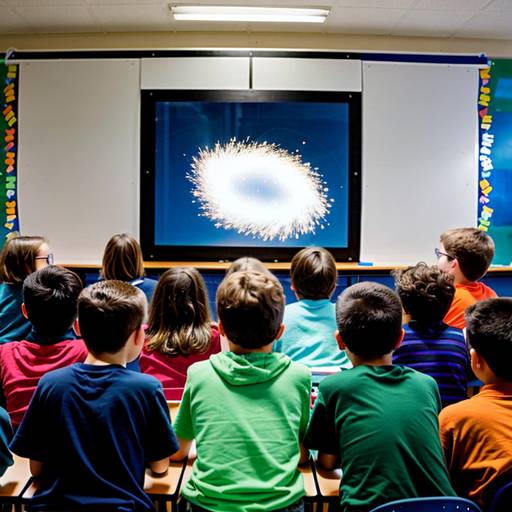
This 5th-grade physical science lesson focuses on the concepts of motion and forces. Students begin by discussing their observations of movement in everyday life and learn key terms such as motion, force, and friction. The lesson includes direct instruction on how motion is defined and measured and how different forces influence an object's speed and direction.
In small groups, students conduct hands-on experiments using toy cars, ramps, and weights to explore how various factors, such as mass and height, affect motion. They measure the distance and time taken for cars to travel down ramps, recording their findings.
After the experiments, students engage in a guided class discussion to share their observations and analyze the impact of forces on motion, encouraging critical thinking about real-world applications. The lesson concludes with a reflection assignment, prompting students to connect the concepts of motion and forces to their own experiences. Overall, this interactive lesson provides an engaging way for students to grasp fundamental physical science principles.
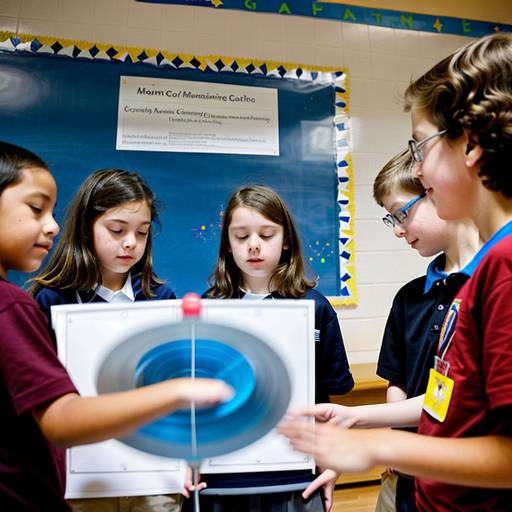
This fifth-grade science lesson focuses on understanding the concepts of motion and forces. Students will learn about different types of forces, including gravity, friction, pushes, and pulls, and explore how these forces affect the movement of objects.
The lesson begins with an engaging discussion to activate prior knowledge, followed by a direct instruction segment that provides definitions and examples of key concepts. Students will then participate in a hands-on experiment where they will work in small groups to test how varying ramp heights and surfaces influence the distance a toy car travels. They will record their observations on worksheets and engage in discussions to analyze their findings.
Finally, groups will present their results to the class, reinforcing their understanding of the impact of forces on motion. Assessment will be based on the collected worksheets and group presentations. The lesson encourages collaboration and critical thinking, with opportunities for extension activities that promote further exploration of the topic.
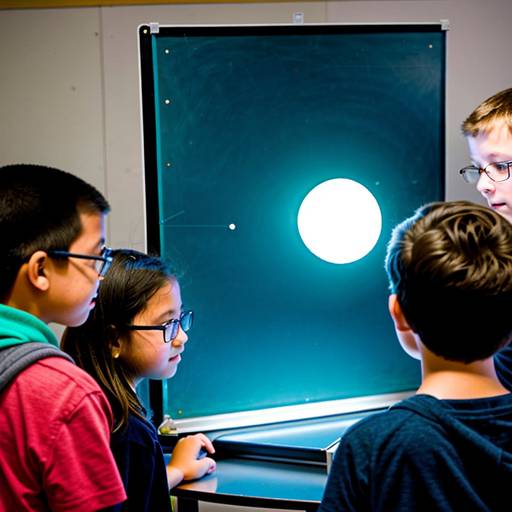
In this 5th-grade physical science lesson, students will explore the concepts of forces such as gravity, friction, and magnetism, and how these forces influence motion. The class will begin with an introduction to the topic, discussing real-world examples of forces in everyday life. Students will then engage in interactive group activities, conducting hands-on experiments where they test how different surfaces affect the distance and speed of toy cars on ramps. Each group will observe and record their findings about the effects of different types of forces on motion. The lesson concludes with a class discussion, where students can share their observations and insights, reinforcing key vocabulary and concepts. Assessment will be based on the accuracy of their worksheets and participation in discussions, providing a comprehensive understanding of the dynamics of forces and their practical applications. Safety measures will be in place during all experimental activities. Extensions for advanced learners include mini-projects related to forces in sports and simple machine concepts.

In this 5th-grade science lesson, students explore the concepts of energy, motion, and forces through hands-on experimentation. They will learn about kinetic energy (energy of motion) and potential energy (stored energy based on position) by conducting an experiment using toy cars, ramps, and weights. Divided into small groups, students will measure the height of their ramps and observe how different weights affect the speed of the toy cars as they roll down. Through data collection and discussion, students will analyze the relationship between potential and kinetic energy and understand how energy is transformed during motion. The lesson concludes with a reflection on energy transformations in everyday life and assessment through worksheets and group discussions, encouraging critical thinking and collaboration. Additional exploration options are provided for students who wish to deepen their understanding of energy dynamics.
In this 5th-grade physical science lesson, students will explore the concepts of energy, motion, and waves through engaging hands-on activities. The lesson begins with a discussion about everyday examples of energy, followed by a video illustrating different types of energy in action. Students will work in small groups to conduct experiments, such as launching small balls with rubber bands and creating waves using strings and shallow trays of water.
Throughout these activities, students will make observations about how energy affects motion and how it travels in waves. After the exploration phase, the teacher will lead a discussion to clarify scientific concepts such as kinetic and potential energy, reinforcing students' understanding through their observations. To encourage critical thinking, students will reflect on the role of energy in their daily lives.
To evaluate comprehension, students will complete a worksheet that asks questions about their experiments and the principles of energy and waves they learned. The lesson concludes with ideas for follow-up activities, including a potential science fair where students can showcase their own energy-related experiments. By the end of the lesson, students will have a solid understanding of the fundamental principles of energy and motion in the physical world.