
Filters
Level
Grade
Subject
Subject Area
Subject Topic
Standard(s)
Audience
Keyword
DurationMinutes
4th Grade Music Theory Lesson Plans


In this 4th-grade music lesson, students will explore the foundations of rhythm and music theory through engaging activities. The lesson begins with a warm-up call-and-response clapping exercise to build rhythmic awareness. Students will learn about key rhythmic notations—quarter notes, eighth notes, and half notes—while discussing their importance in music and daily life.
Following the introduction, learners will practice clapping exercises and then transition to using rhythm instruments in small groups. Each group will create an original 4-beat rhythm pattern, incorporating the learned notation. After practicing their compositions, groups will perform their rhythms for the class, showcasing their understanding of rhythm.
The lesson not only emphasizes collaboration and creativity but also encourages students to identify rhythms in their everyday lives, making the learning experience relevant and applicable. Assessment will be based on participation, rhythm accuracy, and creativity in group performances. Extension activities will provide further opportunities for exploration and complexity in rhythm.

In this engaging 4th-grade music lesson, students will explore the concept of dynamics in music, focusing on the principles of loudness and softness. The lesson begins with an introduction to dynamic markings such as forte, piano, mezzo piano, mezzo forte, crescendo, and decrescendo, using discussions and interactive call-and-response exercises to reinforce understanding.
Students will then be divided into small groups, each assigned a specific dynamic marking. They will create short musical phrases using instruments or body percussion, incorporating the dynamics they’ve learned. After rehearsal, each group will present their compositions to the class, allowing for constructive feedback and reflection on their performances.
The lesson concludes with a recap of the key concepts and encourages students to listen for dynamics in their favorite music, promoting active engagement with music outside the classroom. Assessment will be based on participation, group performance, and optional written reflections on the dynamic elements found in music they encounter. This lesson provides a hands-on approach to understanding musical dynamics while fostering teamwork and creativity.

In this 4th-grade music lesson, students will explore fundamental concepts of music theory, focusing on rhythm and note values. The lesson begins with a rhythm echo exercise to engage students and introduce the importance of rhythm in music and everyday life. Students will learn about basic note values—whole notes, half notes, quarter notes, and eighth notes—through visual aids and clapping exercises.
Following this introduction, students will work in small groups with percussion instruments to create and rehearse their own rhythmic patterns, combining at least two different note values. Afterward, the class will unite to form a "Rhythm Band," performing their patterns together over a steady background beat, emphasizing collaboration and the layering of rhythms.
To conclude, students will reflect on their learning experience, discussing the significance of rhythm in music and teamwork. They will be encouraged to practice rhythm patterns at home, reinforcing their understanding of the concepts taught. Assessment will involve observing group dynamics, listening to performances, and a short worksheet on note values and rhythm creation. This interactive approach aims to enhance students' musical skills and foster creativity.
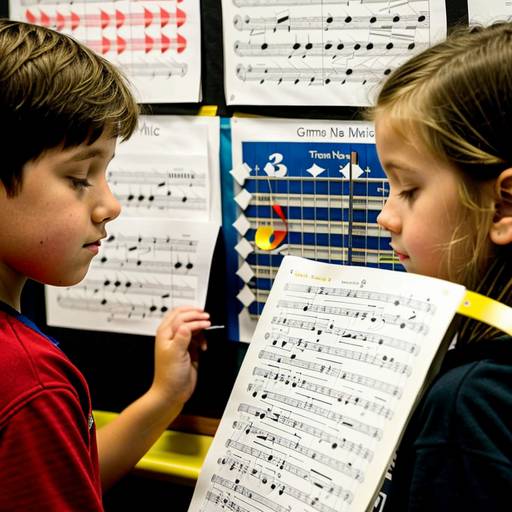
This music lesson for 4th-grade students focuses on introducing and reinforcing the identification of notes on the treble clef staff through engaging activities. The lesson begins with a warm-up game where students connect familiar songs to musical notes, prompting a discussion on the importance of notes in music.
Students are then introduced to the names of the notes in the treble clef and helpful mnemonics to memorize them. Visual aids, including a drawn treble clef on the whiteboard and possibly educational videos, further support this instruction.
The class engages in a guided practice where students complete worksheets identifying notes, followed by an interactive group game that encourages teamwork and quick thinking as they identify notes using flashcards. The lesson concludes with a review and an exit ticket activity to assess understanding. Optional extension activities are provided for students seeking additional practice, ensuring a comprehensive learning experience that fosters both individual and collaborative mastery of music theory concepts.

In this 4th-grade music lesson, students will explore the concept of dynamics in music, focusing on how loudness and softness can enhance expressiveness. The lesson begins with an introduction to dynamic terms, including forte, piano, mezzo forte, mezzo piano, crescendo, and decrescendo. Students will engage in active listening exercises, identifying changes in volume within a selected piece of music.
Following the listening activity, the class will study a familiar song, discussing sections where dynamic contrasts can be applied. Students will be divided into small groups to practice and perform their assigned sections, incorporating appropriate dynamic variations. The lesson concludes with a creative reflection activity where students will draw their own dynamic symbols and discuss their learning experience with a partner.
Assessment will focus on participation in group activities, performances, and the reflective creative task. The lesson is adaptable for diverse learners, ensuring that all students can engage with the material effectively. This approach not only builds understanding of music theory but also fosters teamwork and creativity among students.

In this engaging fourth-grade music lesson, students will explore fundamental music theory concepts related to rhythm and note values. The lesson begins with a warm-up involving clapping patterns to familiarize students with rhythm. Through visual aids, students will learn about different note values, such as quarter notes, eighth notes, half notes, and whole notes, understanding how many beats each represents.
Students will then partake in body percussion activities, creating their own rhythmic patterns. Working in small groups, they will develop a 4-beat rhythmic composition that includes a mix of note values, which they will eventually present to the class. Constructive feedback will be provided to reinforce their learning.
The lesson concludes with a group reflection where students share their learnings and feelings about the activities. Lastly, they will perform a collective rhythmic piece together, solidifying their understanding of rhythm and the concept of maintaining a steady beat as a group. Assessment will focus on student participation, the quality of rhythmic patterns created, and adherence to the concepts taught throughout the lesson. Extension ideas encourage students to create their own rhythm compositions at home and explore melody in future music classes.

In this 4th-grade music lesson, students will explore the concept of dynamics—how music can vary in loudness and softness. The lesson begins with a discussion on their experiences with dynamic sounds in music, followed by an introduction to key terms like "piano," "forte," "crescendo," and "decrescendo." Students will engage in a listening activity, analyzing music clips that exemplify these dynamics and expressing their feelings about the changes in sound.
Next, the class will participate in a vocal exercise, actively demonstrating contrasts in volume through their voices and movements. In small groups, students will explore classroom instruments to create their own short musical pieces that incorporate at least two dynamic changes. Each group will present their composition to the class, reflecting on how they used dynamics to enhance their music.
The lesson concludes with a brief discussion and encourages students to observe dynamics in their favorite songs at home for further exploration. Performance and collaboration will be assessed throughout the session, fostering creativity and a deeper understanding of musical dynamics.

In this 4th-grade music lesson plan, students will focus on identifying and naming notes on the musical staff, specifically within the treble clef. The lesson begins with a warm-up singing activity to engage the class, followed by direct instruction where the teacher explains the staff lines and spaces. Students will learn the note names using memorization techniques and visual aids, such as flashcards.
After the instruction, the class will participate in a guided practice session, where they will label notes on printed staff paper with the correct names, working together as a group. The highlight of the lesson is a fun relay activity, where students compete in teams to match note name flashcards with their corresponding positions on the staff.
The session concludes with a brief review of key concepts, allowing students to share their newfound knowledge. Assessment is built into the lesson through observation of participation and accuracy in activities, along with a follow-up quiz in the next lesson to reinforce learning. Overall, the lesson promotes collaboration and interaction while laying a solid foundation in music theory.

In this 4th-grade music theory lesson, students will explore the concept of musical note identification and the values associated with them. The session begins with a warm-up song, followed by a discussion about musical notes and the treble clef staff. Through direct instruction, students will learn the names of notes on the staff, using mnemonic devices to aid memory, and understand the different note values: whole notes, half notes, quarter notes, and eighth notes.
During guided practice, students will work in pairs to match note name flashcards to their corresponding positions on staff sheets and will engage in rhythmic clapping exercises to solidify their understanding of note durations. They will then complete individual worksheets that reinforce their knowledge of note identification and values.
The lesson concludes with a review of what they learned and a fun challenge where students can demonstrate their understanding by identifying specific notes from flashcards. Assessment will include observing participation, reviewing the completed worksheets, and evaluating performance during the challenge. Extensions of the lesson may involve simple composition activities or technology integration. The overall goal is to foster a positive learning environment and encourage student engagement in music theory.

In this engaging 4th-grade music lesson, students will explore the basics of music theory by learning to identify and name musical notes on the treble staff. The lesson begins with a discussion on the importance of note names and the treble clef. Students will then learn about the musical alphabet (A through G) and how it corresponds to the lines and spaces of the staff, using mnemonic devices for easy recall.
Through a fun note-naming game, students will work in groups to reinforce their understanding by identifying notes on flashcards. They will also engage in a creative activity where they draw notes on sticky squares and label them, encouraging artistic expression alongside musical learning. The lesson concludes with a review of key concepts, promoting a collaborative discussion on what students found easy or challenging. Assessment will be based on participation, accuracy in labeling, and creativity in the drawing activity.
Overall, this lesson provides an interactive and enjoyable way for students to build foundational skills in music theory.