
Filters
Level
Grade
Subject
Subject Area
Subject Topic
Standard(s)
Audience
Keyword
DurationMinutes
3rd Grade Earth Science Lesson Plans

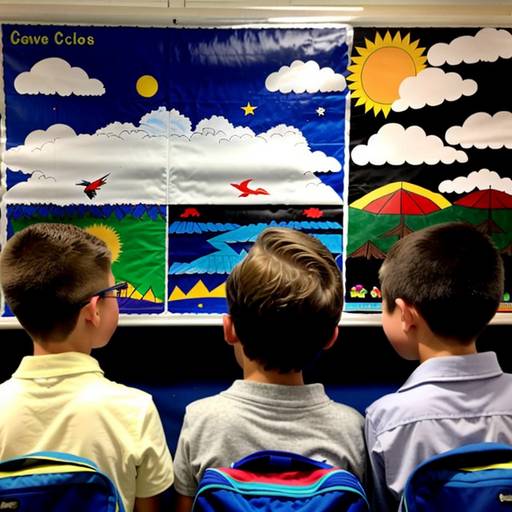
In this Earth Science lesson for 3rd graders, students will explore fundamental concepts of weather and its various elements, including temperature, precipitation, wind, humidity, and clouds. The lesson begins with a discussion to elicit students' prior knowledge about weather, followed by observations of current weather conditions either outside or through a window. Students will record their observations in weather journals.
Next, they will work in small groups to predict weather conditions using flashcards and a temperature chart, encouraging critical thinking and collaboration. To reinforce their learning and encourage creativity, students will create artwork representing their favorite type of weather, accompanied by descriptive sentences.
The lesson concludes with a discussion of key takeaways and a gallery walk for students to share their artwork. Assessment will focus on their journal entries, group participation, and engagement in activities. Extensions may include tracking daily weather at home. The lesson offers differentiated support to cater to diverse learners, ensuring everyone can engage meaningfully with the topic.
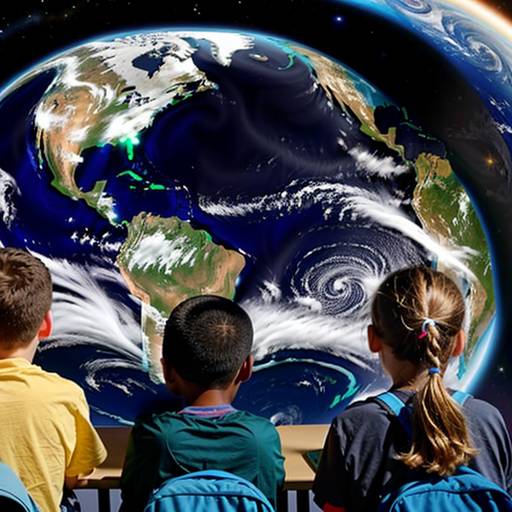
In this 1-hour Earth Science lesson for 3rd graders, students will explore fundamental concepts related to weather and the atmosphere. The lesson begins with a discussion about the types of weather students experienced recently, followed by an introduction to key vocabulary such as weather, atmosphere, precipitation, forecast, and climate. Using a simple water cycle diagram, the teacher will explain the processes of evaporation, condensation, and precipitation, and discuss various weather conditions with the help of flashcards.
Students will then work in small groups to create their own fictional weather forecasts on construction paper, including drawings of weather symbols and descriptions. They will also consider how different weather affects people, animals, and plants. Each group will present their forecasts to the class, facilitating peer learning and reinforcing understanding.
The lesson concludes with a review of key concepts, as students answer questions that assess their grasp of weather phenomena and the water cycle. Assessment will be based on group participation, the accuracy of weather symbols and descriptions, and individual understanding demonstrated during the conclusion. Extensions include maintaining a weather journal and conducting simple experiments, while adaptations will be made for varying student needs and abilities. Reflections after the lesson will focus on engagement and understanding.