
Filters
Level
Grade
Subject
Subject Area
Subject Topic
Standard(s)
Audience
Keyword
DurationMinutes
3rd Grade Science Lesson Plans

In this 3rd grade life science lesson, students will explore various animal habitats and the unique adaptations that allow animals to thrive in those environments. The session begins with a discussion of different habitats, such as deserts, forests, and oceans, encouraging students to identify the animals that inhabit each one. Following this, the teacher will present information on how specific animal traits contribute to their survival, using a chart to illustrate these connections.
Students will then engage in a matching activity with habitat cards and animal figurines, facilitating group discussions about why certain animals are suited to particular habitats. For the independent activity, students will create 3D models of a habitat of their choice, incorporating at least three animals and demonstrating their understanding of the topic.
The lesson concludes with presentations, where students share their habitat models and insights, promoting reflection on what they learned about animal adaptations and habitats. Assessment will focus on student participation, creativity, and accuracy in their models, with extensions available for further exploration of the topic. Modifications will ensure all students can fully participate and grasp the material.
In this 3rd-grade science lesson, students explore the concepts of potential and kinetic energy through engaging activities and discussions. The lesson begins with a brief introduction to energy and its two main types, supported by visual examples from everyday life. Students then participate in a hands-on activity where they work in small groups to create ramps for toy cars or marbles. They experiment with different ramp heights to observe how potential energy is converted into kinetic energy. Measurements of how far the cars travel are recorded, promoting teamwork and critical thinking. The lesson concludes with a class discussion that reinforces the concepts and encourages students to share personal examples of potential and kinetic energy. Assessments include observation during activities and the recording of experimental results, ensuring students grasp the foundational principles of energy.
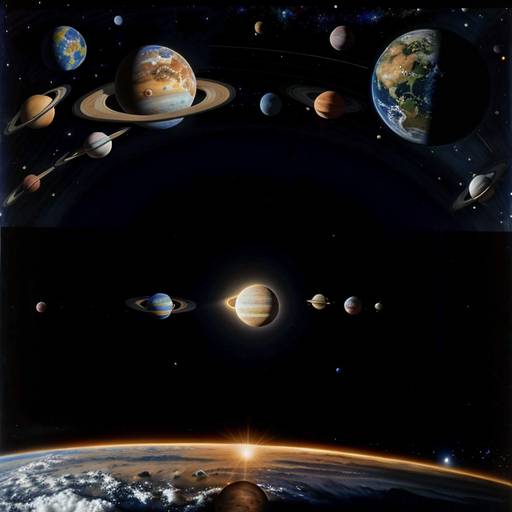
This lesson plan is designed for third-grade students to explore the solar system and learn about the planets that orbit the sun. It begins with an engaging video or animation to capture students' interest, followed by a discussion about their observations of the night sky. The teacher will introduce each planet, highlighting key characteristics and the concepts of orbit and gravity.
Students will participate in guided activities where they work in groups to create fact cards for assigned planets, including drawings and interesting information. They will also build a scale model of the solar system using Styrofoam balls or balloons to represent the planets and string for their orbits.
To reinforce learning, students will complete reflective journal entries about their favorite planet. The lesson concludes with sharing insights and reviewing the order of the planets. Assessment will be based on group interactions and journal reflections. Extensions and adaptations are included to cater to various learning needs, ensuring an engaging and informative experience centered around astronomy.
In this 3rd-grade Earth Science lesson, students will explore various weather types and gain an understanding of how weather patterns affect daily life. The lesson begins with a discussion about personal weather experiences, followed by an introduction to key vocabulary related to weather. Students will learn the basics of weather observation and measurement using simple tools such as thermometers and rain gauges.
They will engage in an interactive activity where they create weather charts to record daily conditions throughout the week, and they will also design weather scene crafts that depict their favorite weather types. The class will encourage sharing of their projects and charts, promoting collaboration and communication.
Assessment will involve participation in activities, the completion of crafts and weather charts, as well as a short quiz at the end of the week to evaluate understanding. The lesson also includes extensions, such as starting a classroom weather station and researching specific weather phenomena, providing opportunities for further inquiry and learning about the complexities of weather and its impact on the world. Reflection will take place after the lesson to identify successes and areas for improvement.
This lesson plan for 3rd graders focuses on the fascinating topic of astronomy, particularly stars and constellations. Students will begin by discussing what they observe in the night sky and watching a short video about the sun, our nearest star. The teacher will present information on various types of stars and the concept of constellations, accompanied by images for visual aid.
Following the presentation, students will work in pairs to create their own constellation on construction paper, using colored pencils and star stickers to enhance their artwork. Each pair will then present their constellation to the class, explaining its name, shape, and any related stories.
To conclude, the class will review the key concepts learned about stars, and students will complete an exit ticket reflecting on what they learned. Assessment will occur through observations during presentations and the completion of a worksheet with star facts. The lesson also offers ideas for extensions, such as a stargazing night with parents and an inclusive reading corner for further exploration of astronomy. Differentiation strategies are included to support a range of learners. Overall, this lesson aims to provide an interactive and engaging experience that enhances students' understanding of stars and constellations.
In this 3rd-grade physical science lesson, students will explore the concepts of pushes and pulls as they relate to forces and motion. The lesson begins with an engaging discussion about everyday examples of forces, followed by a hands-on experiment where students build ramps and observe the effects of adding weight to toy cars on their speed. Working in small groups, students will record and compare their findings, facilitating a deeper understanding of how forces impact motion. The class discussion will encourage students to reflect on their observations and connect them to real-life examples. To conclude the lesson, students will share their insights by writing down instances of pushes and pulls they encounter at home. Assessment will be based on participation, group findings, and individual reflections on their learning experiences. Adaptations will be provided to support diverse learners, while extensions will challenge more advanced students to design their own racecars, further investigating the relationship between design, weight, and motion.
This lesson plan is designed for third-grade students to explore Earth Science with a focus on rocks. It begins with an engaging introduction featuring videos or images of unique rock formations to spark student interest. The lesson introduces the three main types of rocks—igneous, sedimentary, and metamorphic—along with their characteristics and formation processes, and includes a discussion on the rock cycle.
Students engage in hands-on activities where they work in small groups to observe and classify rock samples using hand lenses and classification charts, completing a worksheet to document their findings. Following this guided exploration, students create posters centered on their favorite rock type, which they will present to the class. The lesson concludes with a review of key concepts and an exit ticket activity to assess student understanding and address any lingering questions. Through collaborative discussions, artistic expression, and observational skills, students gain a foundational understanding of rocks and their significance in the Earth's systems.
In this 3rd grade science lesson, students will explore the concepts of motion and the various forces that influence it. The lesson begins with an engaging introduction where students discuss their observations of how objects, like toy cars, move. Key terms such as motion, force, push, and pull are introduced and explained through real-life examples of different types of motion: straight, circular, and back-and-forth.
Following the introduction, students participate in hands-on activities that involve experiments with toy cars on ramps and balloon-powered cars. In small groups, they will test how different weights affect the distance that toy cars travel when released from a ramp, and observe the effects of balloon propulsion on their specially designed cars. Throughout the activities, students will record their observations and data on worksheets.
The lesson concludes with a group discussion where students share their findings, reflect on their learning experiences, and consider how forces like gravity and friction affect the motion of objects. Assessment includes the completion of worksheets and the quality of group presentations. Extensions encourage students to apply their understanding of motion to real-world examples and future projects. Overall, the lesson aims to foster a practical understanding of physical science concepts related to motion among young learners.
This lesson plan focuses on introducing 3rd-grade students to the major parts and systems of the human body through interactive activities and presentations. The lesson begins with a discussion to assess prior knowledge and introduces key body parts using a visual aid. Students are divided into groups, each assigned a specific body system—skeletal, muscular, circulatory, or respiratory—to research and present to the class. This collaborative learning encourages engagement as they share what they learn about the functions and importance of their designated systems.
Following the presentations, students participate in a hands-on activity where they create their own diagrams of the human body, labeling major parts and systems creatively. The lesson concludes with a discussion reflecting on key learnings and the significance of maintaining a healthy lifestyle to support bodily functions. Students are assessed through their diagrams and group presentations, and extension activities provide opportunities for further exploration. Accommodations are included to ensure all learners can engage meaningfully. Overall, the plan fosters a foundational understanding of human biology while promoting teamwork and creativity.
This lesson plan focuses on introducing 3rd-grade students to the concept of matter in physical science, emphasizing the three states: solids, liquids, and gases. The lesson begins with an engaging video or demonstration to capture students' interest, followed by a discussion that prompts them to identify everyday examples of each state of matter.
The instruction includes clear definitions and properties of matter, explaining how it can change states. Students then participate in a hands-on, interactive activity at three different stations, where they observe and describe the characteristics of solids, liquids, and gases using various materials. Each station is complemented by a worksheet for students to record their observations.
The lesson concludes with a group discussion and a drawing activity that allows students to express their understanding of matter creatively. Assessment is based on their participation, completed worksheets, and drawings. Differentiation strategies are included to support varying learning needs, as well as extension activities for further exploration. The overall goal is to provide students with a foundational understanding of matter and its properties through engaging and interactive experiences.