
Filters
Level
Grade
Subject
Subject Area
Subject Topic
Standard(s)
Audience
Keyword
DurationMinutes
1st Grade Language Arts Lesson Plans


In this 1st grade Language Arts lesson plan, students engage in narrative writing by exploring the key elements of a story: characters, setting, and plot. The lesson begins with a read-aloud of a short narrative, leading to a discussion that identifies these components. Students then choose a picture prompt for inspiration and brainstorm ideas related to their own stories. After outlining their narratives in blank storybooks, they dedicate time to write and illustrate their stories, with teacher support as needed. The lesson concludes with students sharing their creations in pairs or small groups, fostering confidence and peer interaction. Assessment is based on participation, the inclusion of narrative elements, and storytelling skills, while extensions and differentiation strategies enhance the learning experience for all students. The lesson promotes creativity and collaboration, making the writing process an enjoyable adventure for young learners.

In this 1st-grade Language Arts lesson plan, students will explore the elements of fiction by identifying characters and settings in stories. The lesson begins with a discussion of favorite stories to engage students and introduce key vocabulary. A selected picture book is read aloud, with the teacher modeling comprehension strategies through think-aloud techniques. Students then work in pairs to fill out a graphic organizer that identifies the characters and setting of another picture book. They will also use sticky notes to share their favorite characters on a class board and create their own drawings of story settings. The lesson concludes with a share-out session to encourage reflection and discussion, while bookmarks with reading strategies are distributed to support future reading at home. Assessment will be informal, based on participation and the completion of the graphic organizer, with differentiation strategies in place for varied student needs. Extension activities include creating a classroom display of character and setting drawings and sharing books at home for further discussion.

In this 1st Grade Language Arts lesson, students will engage in an interactive reading experience where they explore the characters, setting, and events of a selected picture book. The lesson begins with students predicting the story's content based on its cover, followed by a read-aloud where they are encouraged to make predictions and answer questions about the text. After the read-aloud, students will complete a graphic organizer to illustrate and label the main character(s), setting, and a key event from the story. They will also fill out a prediction card to express their thoughts on what might happen next. The lesson concludes with students sharing their findings with the class, reinforcing their understanding of essential story elements. Throughout the lesson, assessment will be conducted through observation and collection of the students' work to gauge their comprehension and engagement in reading. Extension activities will encourage independent reading at home, while modifications will support students requiring extra help.
In this 1st-grade Language Arts lesson, students will explore the foundational elements of sentence structure, specifically focusing on subjects, verbs, and objects. The lesson begins with a fun song or video to pique interest, followed by a discussion to introduce what sentences are.
During direct instruction, the teacher models a simple sentence, breaking it down into its components. Students then engage in a guided practice activity where they work in small groups to create their own sentences using word cards. Following this, each student will independently compose a sentence on a strip of paper or large sheet, illustrating their work to enhance creativity.
The lesson concludes with a sharing session where students present their sentences to the class, reinforcing their understanding of sentence structure. Assessment will be ongoing through observations during activities and by evaluating the sentences students create, ensuring they grasp the essential components of complete sentences. Modifications are included to support diverse learners, allowing all students to participate and succeed. This interactive and engaging approach helps build students' confidence in their grammar skills.
In this 1st grade language arts lesson, students will learn about proper nouns and the importance of capitalization. The lesson begins with a discussion on nouns, followed by an introduction to proper nouns, including names, places, and days of the week. Students will engage in guided practice by identifying proper nouns in sentences on a worksheet, where they'll circle and rewrite the sentences with the correct capitalization. The lesson incorporates interactive elements, including flashcards and a story reading, where students will shout out proper nouns as they come up. Participation is encouraged with rewards like stickers, and assessment will be done through worksheet reviews and classroom observations. Differentiation strategies are included to support varying student needs, ensuring an inclusive learning environment. Overall, the lesson aims to enhance students' understanding of grammar while making the learning experience enjoyable.

In this 1st Grade Language Arts lesson, students will focus on understanding and applying the rules of capitalization, specifically at the beginning of sentences and for proper nouns. The lesson begins with a warm-up activity where students share their names and observe capitalization in writing. A read-aloud from a picture book reinforces the concept of capital letters.
Following this, a mini-lesson provides direct instruction on how to capitalize sentences and proper nouns, accompanied by examples on the whiteboard. Students will engage in a collaborative activity using sentence strips, where they will identify and correct capitalization errors.
For independent practice, they will work on a worksheet containing sentences that require capitalization corrections. The lesson concludes with students sharing their corrected sentences and receiving rewards for their efforts. Assessment will be conducted through observation during activities and by reviewing the worksheets for understanding. Extension activities are provided for advanced learners and additional support for those who may need it.

This 1st grade Language Arts lesson focuses on teaching students the importance of capitalization in sentences. The lesson begins with a discussion about capitalization, specifically the need to start sentences with a capital letter and to capitalize proper nouns. Students engage in interactive activities where they identify errors in jumbled sentences and distinguish between common and proper nouns. They then complete a worksheet that reinforces these concepts by providing sentences with missing capital letters for them to correct. The lesson concludes with a class review and reflection on what students learned about capital letters. Assessment is conducted through the collection of worksheets, and students receive encouragement through stickers or stamps for their successful participation. Additional support and challenges are provided for students based on their individual needs, and opportunities for extension activities are suggested to further reinforce capital letter usage.
In this 1st Grade Language Arts lesson, students will enhance their reading comprehension skills by focusing on identifying main ideas and supporting details within a story. The lesson begins with an engaging read-aloud of a picture book, encouraging students to anticipate the story's content. After reading, a group discussion will help students articulate the main idea while brainstorming key details that support it. Students will then fill out a graphic organizer to visually represent their understanding, followed by a creative activity where they illustrate a favorite scene from the story. The lesson concludes with student presentations and a summary of how identifying main ideas and details can deepen comprehension. Assessment will be based on participation, the completion of the graphic organizer, and the quality of illustrations. Extensions will be provided for advanced and struggling readers to ensure that all students are supported in their learning.
This 1st-grade Language Arts lesson focuses on enhancing reading comprehension through the exploration of characters in a story. Students will engage in a read-aloud of a picture book, discussing and identifying the main characters and their adventures. They will create character maps to illustrate their understanding of the characters' traits and summarize their respective adventures. Through small group discussions, students will express questions and thoughts about the characters, fostering collaborative learning. The lesson concludes by encouraging students to connect their favorite characters to their own storytelling experiences. Various assessments will measure student participation and comprehension, while extensions and adaptations will ensure inclusivity and challenge for all learners.
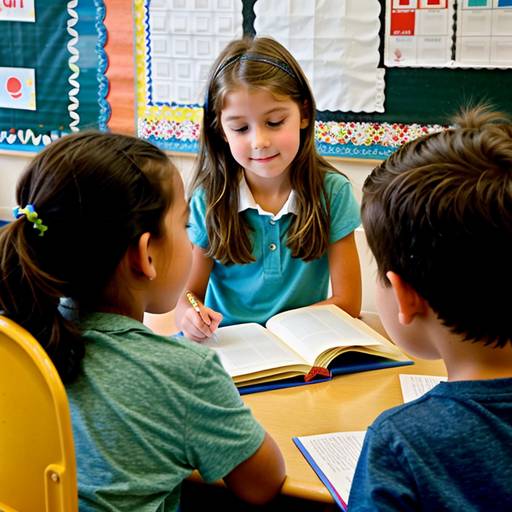
This first-grade language arts lesson plan focuses on introducing students to two primary reading genres: fiction and non-fiction. The lesson begins with a class discussion about what students enjoy about reading, followed by a read-aloud session featuring both a fiction story and a non-fiction book. Through guided questions, students explore the characteristics that differentiate the two genres. A genre sorting activity allows students to work in pairs to categorize flashcards into fiction and non-fiction, reinforcing their understanding of the concepts.
Students then reflect on their learning by creating a graphic organizer where they draw and describe their favorite book from each genre. The lesson concludes with a sharing session that highlights students' preferences, reinforcing the idea that both genres offer unique reading experiences. Assessment is based on student participation and the completion of their graphic organizers. Extensions include a genre-themed reading corner and monthly genre explorations, encouraging ongoing engagement with diverse reading materials.