
Math Lesson Plan
Measuring Up Lesson Plan

Measuring Up

Exploring Length and Temperature!

View Lesson

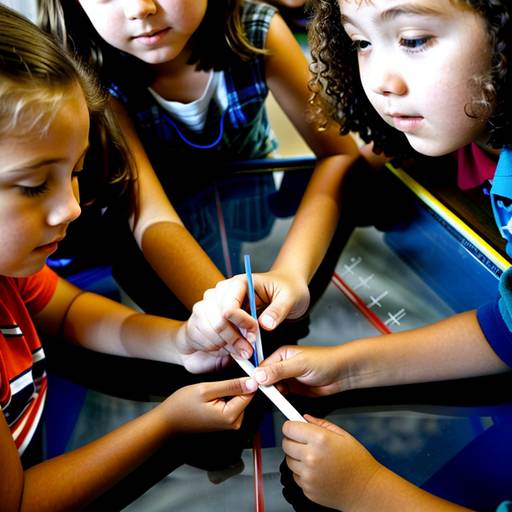
This 3rd-grade math lesson focuses on the concepts of measurement, specifically length and temperature. Students will learn how to measure objects using rulers in both inches and centimeters, and understand how to read temperatures using thermometers, distinguishing between Fahrenheit and Celsius.

The lesson begins with an engaging discussion about measurement in everyday life, followed by direct instruction that demonstrates the proper use of measurement tools. Students will then participate in guided practice by measuring various classroom objects and recording temperature readings from liquids.

Following this, learners will independently complete a worksheet that includes measuring items and converting temperature between Fahrenheit and Celsius. The lesson concludes with a group discussion to review findings and reinforce the importance of measurement in daily activities. Assessment will be based on observation and worksheet completion, with extensions available for further exploration of measurement concepts. Overall, this lesson aims to provide a hands-on and interactive learning experience that enhances students' understanding of measurement.

View Lesson

CCSS.3.MD.A.1
CCSS.3.MD.A.1
Tell and write time to the nearest minute and measure time intervals in minutes. Solve word problems involving addition and subtraction of time intervals in minutes, e.g., by representing the problem on a number line diagram.
CCSS.3.MD.A.2
CCSS.3.MD.A.2
Measure and estimate liquid volumes and masses of objects using standard units of grams (g), kilograms (kg), and liters (l).1 Add, subtract, multiply, or divide to solve one-step word problems involving masses or volumes that are given in the same units, e.g., by using drawings (such as a beaker with a measurement scale) to represent the problem.2
CCSS.3.MD.B.3
CCSS.3.MD.B.3
Draw a scaled picture graph and a scaled bar graph to represent a data set with several categories. Solve one- and two-step "how many more" and "how many less" problems using information presented in scaled bar graphs. For example, draw a bar graph in which each square in the bar graph might represent 5 pets.
CCSS.3.MD.C.6
CCSS.3.MD.C.6
Measure areas by counting unit squares (square cm, square m, square in, square ft, and improvised units).
CCSS.3.MD.C.7
CCSS.3.MD.C.7
Relate area to the operations of multiplication and addition.
CCSS.3.MD.C.7.a
CCSS.3.MD.C.7.a
Find the area of a rectangle with whole-number side lengths by tiling it, and show that the area is the same as would be found by multiplying the side lengths.
CCSS.3.MD.C.7.b
CCSS.3.MD.C.7.b
Multiply side lengths to find areas of rectangles with whole-number side lengths in the context of solving real world and mathematical problems, and represent whole-number products as rectangular areas in mathematical reasoning.
LevelElementary School
Grade3rd Grade
SubjectMath
Subject AreaMeasurement
Subject TopicTemperature
Age Range8 to 9
AudienceGroup
LanguageEnglish
Duration60 mins