
Language Arts Lesson Plan
Exploring Story Worlds Lesson Plan

Exploring Story Worlds

View Lesson

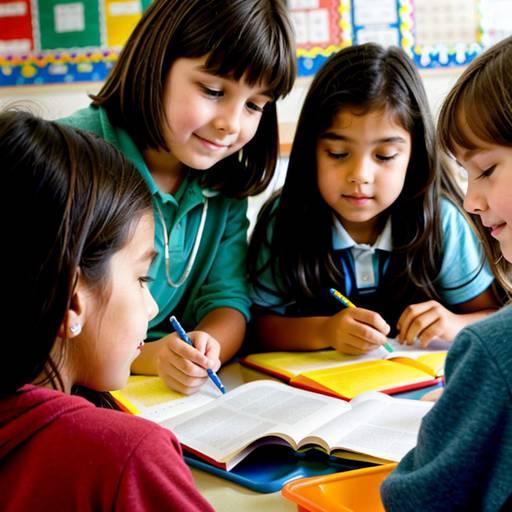
This 2nd-grade Language Arts lesson plan focuses on enhancing reading comprehension through an engaging storybook reading experience. Students will begin by discussing their favorite stories and their adventures before a guided reading session of a selected book, where they will learn to identify key story elements such as characters, setting, and plot. Throughout the reading, students will be encouraged to ask questions and share their thoughts using sticky notes. After the reading, the class will engage in a discussion to reflect on the story and its messages.

Students will then create a story map graphic organizer that includes drawings and written summaries of the key story elements they identified. Finally, students will share their story maps with the class, promoting peer feedback and reinforcing their understanding. The lesson will be assessed through observation and review of students' completed story maps, allowing differentiation for varying reading levels. Overall, the lesson aims to foster a love for reading while developing comprehension skills.

View Lesson

CCSS.RL.2.1
CCSS.RL.2.1
Ask and answer such questions as who, what, where, when, why, and how to demonstrate understanding of key details in a text.
CCSS.RL.2.2
CCSS.RL.2.2
Recount stories, including fables and folktales from diverse cultures, and determine their central message, lesson, or moral.
CCSS.RL.2.3
CCSS.RL.2.3
Describe how characters in a story respond to major events and challenges.
CCSS.RL.2.4
CCSS.RL.2.4
Describe how words and phrases (e.g., regular beats, alliteration, rhymes, repeated lines) supply rhythm and meaning in a story, poem, or song.
CCSS.RL.2.5
CCSS.RL.2.5
Describe the overall structure of a story, including describing how the beginning introduces the story and the ending concludes the action.
CCSS.RL.2.6
CCSS.RL.2.6
Acknowledge differences in the points of view of characters, including by speaking in a different voice for each character when reading dialogue aloud.
CCSS.RL.2.7
CCSS.RL.2.7
Use information gained from the illustrations and words in a print or digital text to demonstrate understanding of its characters, setting, or plot.
CCSS.RL.2.9
CCSS.RL.2.9
Compare and contrast two or more versions of the same story (e.g., Cinderella stories) by different authors or from different cultures.
CCSS.RL.2.10
CCSS.RL.2.10
By the end of the year, read and comprehend literature, including stories and poetry, in the grades 2–3 text complexity band proficiently, with scaffolding as needed at the high end of the range.
CCSS.SL.2.1
CCSS.SL.2.1
Participate in collaborative conversations with diverse partners about grade 2 topics and texts with peers and adults in small and larger groups.
CCSS.SL.2.1.a
CCSS.SL.2.1.a
Follow agreed-upon rules for discussions (e.g., gaining the floor in respectful ways, listening to others with care, speaking one at a time about the topics and texts under discussion).
CCSS.SL.2.1.b
CCSS.SL.2.1.b
Build on others' talk in conversations by linking their comments to the remarks of others.
CCSS.SL.2.1.c
CCSS.SL.2.1.c
Ask for clarification and further explanation as needed about the topics and texts under discussion.
LevelElementary School
Grade2nd Grade
SubjectLanguage Arts
Subject AreaReading
Subject TopicReading Comprehension
Age Range7 to 8
AudienceGroup
LanguageEnglish
Duration60 mins