
Filters
Level
Grade
Subject
Subject Area
Subject Topic
Standard(s)
Audience
Keyword
DurationMinutes
Preschool Earth And Space Lesson Plans

In this preschool science lesson, students will explore fundamental concepts related to Earth and space through engaging hands-on activities. The class begins with a discussion about Earth, using a large blue balloon to illustrate its features. Each child will then decorate a small balloon to represent a planet, allowing them to express their creativity while learning basic facts about the solar system.
Next, students will conduct a simple experiment using clear cups of water to represent Earth, adding cotton balls as clouds to observe how they form. The activity will include using flashlights to simulate sunlight, prompting discussions about day and night and the weather's role in our environment.
The lesson will culminate in a creative activity where students will create their own night sky on black construction paper, using stars and constellations to visually represent the cosmos. Throughout the lesson, students will be encouraged to share their discoveries and reflections on what they have learned.
The session aims to foster curiosity, promote vocabulary development, and enhance understanding of scientific principles related to Earth and space in a fun, interactive way.
This preschool science lesson introduces young learners to the basic concepts of Earth and Space through engaging storytelling and hands-on activities. It begins with a discussion that sparks children's curiosity about the universe, followed by reading a captivating children's book that explores space, complemented by visuals of planets and stellar phenomena.
Children then participate in a creative craft activity where they design their own solar system using construction paper, encouraging exploration and imaginative thinking about the colors and characteristics of various celestial bodies.
The lesson also includes a sensory experience with light and dark, using a flashlight to illustrate how the sun lights up the day while stars become visible at night.
It concludes with a sharing session, allowing children to present their crafts and express what they enjoyed and learned. The lesson promotes active engagement, creativity, and a sense of wonder about the universe, while assessment methods focus on participation and individual responses. Opportunities for follow-up activities are also suggested to extend learning beyond the classroom.
This preschool science lesson focuses on introducing young children to the fundamental concepts of Earth and space. The lesson aims for students to recognize basic features of Earth, such as land and water, and celestial bodies like the sun, moon, and stars.
The session begins with a brief introduction where pictures of Earth and space are displayed to spark discussion. Children then engage in an interactive balloon activity, where they handle balloons representing Earth and celestial bodies, promoting tactile exploration and allowing them to express their observations.
Following the balloon activity, children participate in creating their own art pieces on a large poster board, illustrating their understanding of Earth and space using markers, crayons, and stickers. This creative component encourages self-expression and teamwork as children share their creations with peers.
The lesson wraps up with a group discussion, where children share their artwork and reflect on what they’ve learned. A brief story read-aloud reinforces the themes covered in the lesson.
Assessment is based on student participation and engagement throughout the activities, while potential extensions include deeper explorations of related topics, nurturing curiosity about the world and universe. Overall, the lesson serves to foster a foundational understanding of Earth and space in a fun and interactive manner.
This preschool lesson plan introduces young learners to the five senses through an engaging exploration of Earth's and Space's wonders. Over a 39-minute session, students will participate in various hands-on activities at different sensory stations. They will have the opportunity to feel textures from nature, listen to various sounds associated with Earth and space, identify scents, and taste fruits that represent different planets.
Following the sensory exploration, children will create a mural reflecting their experiences, using their senses as inspiration for artistic expression. The lesson concludes with a group discussion allowing students to share their insights and observations. Throughout the session, the teacher will facilitate engagement and assess understanding by observing student participation and encouraging conversation. This interactive and sensory-based approach aims to foster curiosity and a deeper appreciation for the world around them.
In this engaging preschool science lesson, students will participate in hands-on activities to discover Earth’s elements, such as soil, water, and air, while also exploring basic concepts related to the Earth and space. The lesson begins with an interactive discussion that encourages students to share their prior knowledge about the ground, the stars, and the Moon.
Next, students work in small groups to investigate different Earth materials by filling cups with various elements, discussing their observations, and predicting outcomes when mixing soil and water. Following this, the class participates in a celestial simulation using balloons to represent the Earth and Moon, where children learn about orbits by walking in circles and using flashlights to imitate stars in the night sky.
The lesson concludes with a group discussion where students share what they learned and a storytime session featuring a space-themed book to reinforce the concepts introduced. By the end of the lesson, students will have a foundational understanding of Earth and space elements through experiential learning, fostering curiosity and scientific inquiry.
This preschool science lesson introduces young children to the solar system, focusing on Earth as their home planet and providing a general overview of other planets. The lesson begins with an engaging introduction where kids discuss Earth and share their thoughts about it. A story is read to the group to further explore the solar system, followed by a discussion of each planet's unique characteristics.
Children then participate in a craft activity where they create their own imaginative planets using various art supplies, fostering creativity and fine motor skills. Next, they engage in a fun role-playing activity in a makeshift "space shuttle," encouraging active participation and physical movement while enjoying space-themed music.
The lesson concludes with a recap of what they've learned and a brief sharing session. Follow-up activities are suggested to reinforce learning, such as creating a solar system display in the classroom. Overall, the session aims to stimulate curiosity about space, promote creativity, and enhance understanding of basic astronomical concepts.
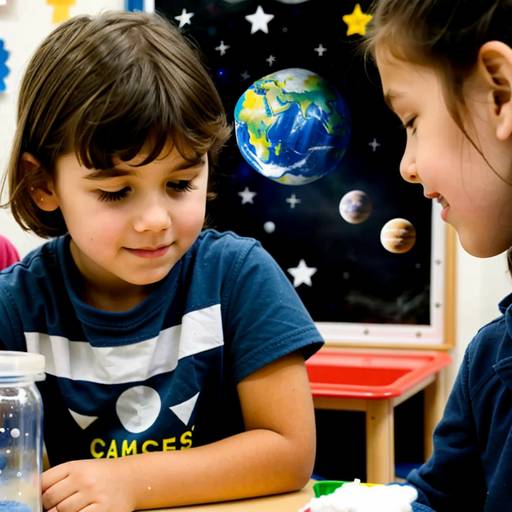
In this preschool science lesson, children will engage in hands-on experiments that introduce them to basic concepts related to Earth and Space. The session begins with a circle discussion to spark curiosity and activate prior knowledge about plants and the night sky. Students will participate in planting seeds in clear cups, learning about what plants need to grow, while also making predictions about their seed growth. Following this, they will create starry night artwork using dark construction paper and glitter, simulating stars while discussing celestial bodies and their twinkling appearance.
Throughout the lesson, children will observe, share experiences, and reflect on their activities, enhancing their scientific curiosity and observation skills. The lesson concludes with a collaborative review of what they learned, reinforcing the concepts introduced, and culminating in a fun song or rhyme related to Earth and Space. This interactive approach aims to foster a sense of wonder and an eagerness to explore the natural world.
This preschool science lesson engages young children in exploring basic concepts related to the Earth and the sky, focusing on elements such as the sun, moon, stars, and clouds. The session begins with a circle time discussion, allowing students to share their knowledge and observations. A read-aloud of a picture book enhances their understanding, prompting discussions about the characteristics of Earth and sky features.
Following the story, students participate in a hands-on creative activity where they use construction paper, cotton balls, and star stickers to create their own sky scenes, reinforcing their learning through artistic expression. The lesson concludes with a sharing session, allowing children to present their artwork and express their favorite aspects of Earth and the sky. An optional outdoor exploration further enriches their experience by providing a chance to observe the natural world directly.
Overall, the lesson fosters curiosity and appreciation for the planet and the universe, while promoting interactive learning and creativity.
In this preschool lesson plan, students explore the five senses while connecting them to concepts related to Earth and space. The class begins with an introduction to the senses, followed by interactive sensory stations where students engage in hands-on activities. These stations allow them to touch various materials, observe images, listen to nature sounds, smell different scents, and taste edible items related to Earth. After rotating through the stations, students create sensory-inspired artwork using crayons and markers, reflecting their experiences. The lesson concludes with a group discussion where students share their artwork and insights, reinforcing how their senses help them understand the world around them. This engaging approach fosters curiosity and enhances sensory awareness in relation to scientific concepts.
- Touch and Feel - Students will explore various textures representing Earth's surfaces.
- Sound Exploration - They will listen to nature and space-themed sounds, fostering a connection to the auditory elements of the environment.
- Taste of Earth - Students will taste small pieces of fruit, discussing how Earth's plants provide food and how astronauts can adapt their diets in space.
- Visual Wonders - Using flashlights and magnifying glasses, students will investigate light and examine images of celestial bodies, discussing color and visual differences.
- Creative Expression - Finally, they will express their ideas through drawing, illustrating their perceptions of Earth and space.
The lesson culminates in a group reflection where students share their experiences, followed by a story that reinforces the key concepts. This hands-on approach promotes curiosity and a deeper understanding of the natural world, encouraging students to recognize how their senses play a role in their observations. Extensions for the lesson include outdoor sensory activities and at-home exploration tasks for families. Assessment will focus on student participation and understanding demonstrated during discussions and creative expressions.