
Filters
Level
Grade
Subject
Subject Area
Subject Topic
Standard(s)
Audience
Keyword
DurationMinutes
5th Grade Multiplication Lesson Plans

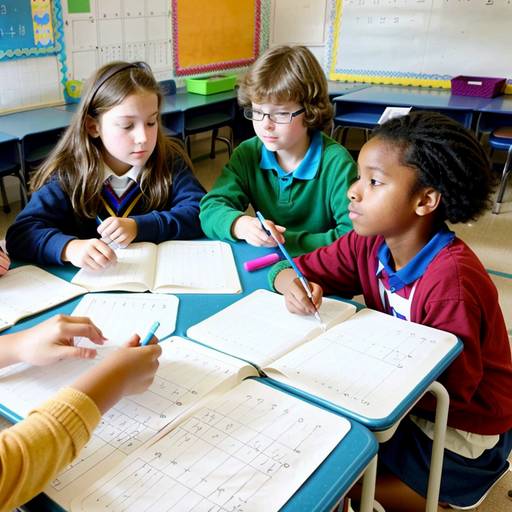
In this 5th-grade mathematics lesson focused on multiplication, students will develop an understanding of multiplication as both repeated addition and grouping. The session begins with an engaging discussion to connect multiplication with real-life scenarios. Educators will introduce core concepts such as factors and products, utilizing visual aids and group modeling with counters.
Students will actively participate in a hands-on activity called "Multiplication Stations," where they rotate through various engaging tasks, including building arrays, using flashcards for speed practice, and solving multiplication word problems. After the group activities, students will complete a worksheet to reinforce their understanding individually.
The lesson wraps up with a recap discussion and an exit ticket activity, allowing students to express one multiplication fact and its importance. Throughout the lesson, teachers will differentiate support for advanced and struggling learners and assess student understanding through observation, worksheet completion, and exit ticket responses. Overall, the lesson aims to create an interactive and supportive environment for mastering multiplication concepts.
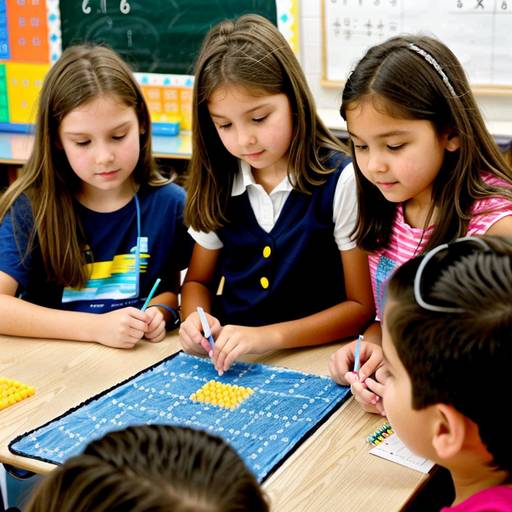
In this 5th-grade math lesson, students will delve into the concept of multiplication, emphasizing its role as repeated addition and its application in everyday scenarios. The lesson begins with an engaging discussion on the importance of multiplication, followed by a warm-up activity where students fill in a multiplication chart to reinforce their knowledge.
Next, students will explore patterns in multiplication tables and create visual arrays using counters to understand multiplication better. A guided practice segment introduces multi-digit multiplication, where students learn various strategies, including the standard algorithm and partial products.
Independent practice allows students to apply their skills to multi-digit multiplication problems through worksheets. The lesson concludes with a reflective journaling session, where students summarize their strategies and insights gained during the activities. Optional extension activities are provided for additional practice or challenges.
Assessment occurs through observation during group work, collection of worksheets, and journal entries. Differentiation strategies are included to support varying skill levels among students. Overall, this lesson fosters collaboration, critical thinking, and a deeper understanding of multiplication.
In this 5th-grade math lesson, students will explore the concept of multiplication as repeated addition. The lesson begins with an engaging discussion that prompts students to think critically about how to calculate items grouped together. Through direct instruction, the teacher will model the multiplication process using manipulatives and demonstrate various strategies such as arrays, number lines, and skip counting.
During guided practice, students will work in small groups to solve multiplication problems using manipulatives, sharing their thought processes with the class. Independent practice will involve worksheets featuring a mix of multiplication scenarios, including word problems and arrays. The lesson concludes with a review of key concepts and a fun multiplication game like Bingo or Memory to reinforce learning.
Assessment will be conducted through observation during group activities and the evaluation of worksheets. Adjustments will be made for learners at different ability levels, and extensions will provide opportunities for students to create their own multiplication story problems. The overall aim is to enhance students' understanding of multiplication and make the learning experience interactive and enjoyable.

This lesson plan focuses on teaching 5th-grade students the concept of multiplication and its various properties, including associative, distributive, and commutative properties. The lesson begins with a review of multiplication as repeated addition, followed by direct instruction on different multiplication methods such as the area model, standard algorithm, and lattice method.
Students engage in guided practice in small groups, where they solve multi-digit multiplication problems using these various strategies and present their solutions to the class. A hands-on activity allows them to create and solve their own multiplication problems using counters or blocks. The lesson also emphasizes real-world applications of multiplication, such as calculating costs and areas, with a fun scenario involving price calculations.
At the end of the lesson, a quick exit ticket is used to assess students' understanding of the concepts covered. For homework, students receive a worksheet with multiplication practice and word problems related to everyday situations. Differentiation strategies are included to support students who need extra help and to challenge those who excel. Overall, the lesson promotes collaboration, critical thinking, and practical application of multiplication skills.