
Filters
Level
Grade
Subject
Subject Area
Subject Topic
Standard(s)
Audience
Keyword
DurationMinutes
5th Grade Vocabulary Lesson Plans


In this 5th-grade Language Arts lesson, students will embark on an engaging exploration of vocabulary by discovering new words and their meanings. The lesson begins with a discussion on recently learned words, fostering an interactive environment. A set of 5-7 new vocabulary words will be introduced, along with their definitions and example sentences, emphasizing the use of context.
Students will then work in pairs to create sentences using the vocabulary words, encouraging collaboration and creativity. After sharing their sentences with the class, each student will independently choose three words to visually represent on chart paper, contributing to a collective vocabulary mural displayed in the classroom.
The lesson concludes with a reflective discussion about the vocabulary learned, where students will write a sentence using one of the new words on a sticky note to add to the mural. Assessment will be informal through observations during activities, with a follow-up quiz to evaluate students' retention of the vocabulary. The lesson incorporates extensions for ongoing vocabulary development and differentiation strategies to support diverse learners.

In this 5th-grade language arts lesson, students will focus on expanding their vocabulary through engaging activities and collaborative learning. The lesson begins with a video or reading passage that introduces several vocabulary words, prompting students to guess their meanings based on context. Following this, the teacher explains how to use context clues and word parts, such as prefixes and suffixes, to understand unfamiliar words.
Students will then work together on context clue worksheets, identifying clues within sentences to predict word meanings and sharing their insights in class discussions. For independent practice, each student will select several vocabulary words to define and use in sentences, culminating in a creative writing activity where they compose a story or paragraph incorporating selected words.
The lesson concludes with students sharing their work with the class and contributing new vocabulary to a classroom word wall to reinforce learning visually. Assessment will include monitoring student participation, reviewing worksheets, and evaluating vocabulary journals for understanding and application. Extensions may include vocabulary games or scavenger hunts for further practice. Overall, the lesson emphasizes interactive and collaborative learning in vocabulary development.
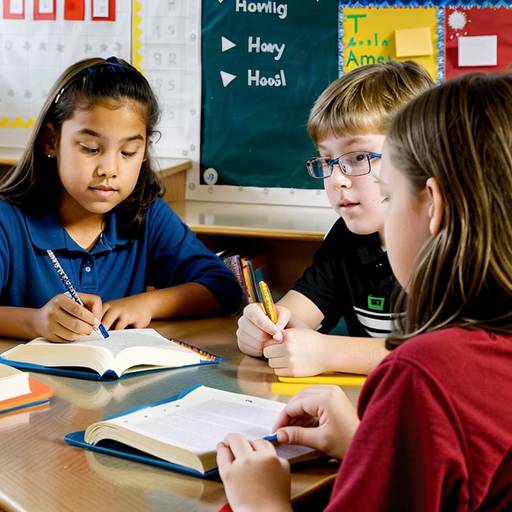
In this 5th-grade Language Arts lesson, students embark on an engaging exploration of new vocabulary words linked to grade-level texts. The lesson begins with a discussion on the importance of vocabulary and introduces a selection of 5 to 10 target words. Students work in small groups to create informative word maps that include definitions, synonyms, antonyms, and creative illustrations. After presenting their maps to the class, students individually craft sentences using two of the new vocabulary words to demonstrate their understanding in context. The lesson wraps up with a reflection activity in their vocabulary journals, where students consider their favorite word and potential usage in their writing and conversations. Assessment focuses on participation during group work, sentence construction, and reflections in journals. Extensions encourage further creativity and use of technology to reinforce vocabulary learning, while differentiation strategies support diverse learning needs within the classroom.

This lesson plan is designed for 5th-grade students to enhance their vocabulary skills through engaging activities and collaborative learning. The lesson begins with an interactive introduction that captures students' attention and prompts a discussion about the importance of vocabulary.
During direct instruction, students are introduced to a list of ten vocabulary words, focusing on their definitions, parts of speech, synonyms, antonyms, and contextual usage. Students practice using context clues to infer meanings of unfamiliar words through examples.
In guided practice, students work in pairs, using flashcards to discuss and create sentences with their assigned vocabulary words, which they then document in their journals. For independent practice, students create illustrated posters for selected vocabulary words, incorporating definitions, sentences, and illustrations to demonstrate their understanding.
The lesson concludes with a gallery walk, where students display their work and provide feedback to peers while sharing their favorite vocabulary words. Assessment includes observation of student engagement, review of journal entries, and evaluation of the vocabulary posters. Differentiation strategies are included to support all learners, and a follow-up activity encourages continuous vocabulary application in students' everyday lives.