
Filters
Level
Grade
Subject
Subject Area
Subject Topic
Standard(s)
Audience
Keyword
DurationMinutes
4th Grade Properties Lesson Plans

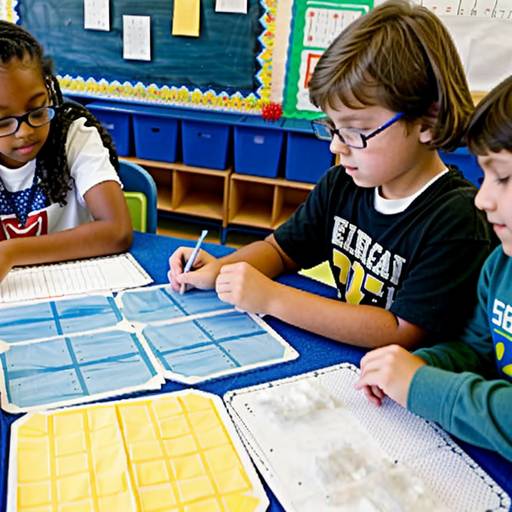
In this 4th-grade math lesson, students will explore the fundamental properties of multiplication, including the commutative, associative, and distributive properties. The lesson begins with an engaging warm-up activity involving multiplication flashcards to activate prior knowledge. Students will learn about each property through direct instruction, with practical examples demonstrating how these properties can simplify calculations.
Following this, students will work in pairs on guided practice problems that require them to apply the properties of multiplication. This collaborative approach encourages discussion and helps reinforce their understanding. Independent practice will then involve worksheets with a variety of multiplication problems and word problems, allowing students to demonstrate their fluency and application of the concepts.
To wrap up the lesson, students will review the key concepts and express their understanding through an exit ticket activity. Assessment will be based on observation during group work, the accuracy of completed worksheets, and the insights gathered from exit tickets. Extensions and modifications will be available to accommodate all learners, ensuring that both advanced and struggling students receive appropriate challenges and support. Reflection following the lesson will help identify effective strategies and areas for improvement in future instruction.
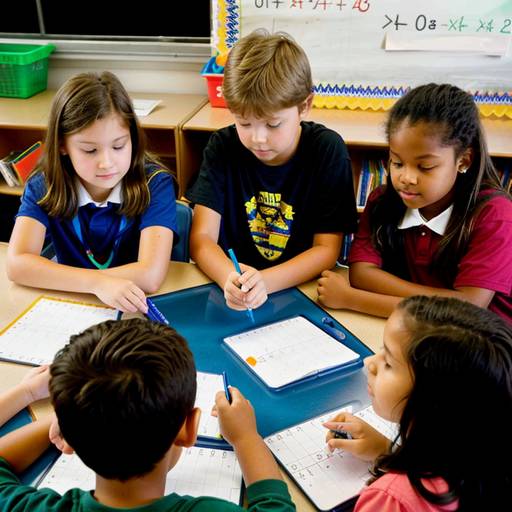
This 4th-grade math lesson focuses on introducing students to the Commutative, Associative, and Identity Properties of Multiplication. The lesson aims to enhance students' understanding and application of these properties through a variety of engaging activities.
Beginning with a discussion about real-life applications of multiplication, the teacher introduces each property with clear definitions and examples. Students then participate in a guided group activity where they explore these properties by rearranging and simplifying multiplication problems using flashcards.
Following this, they work independently on a worksheet that includes various multiplication exercises, word problems, and opportunities to apply the properties they've learned. The lesson concludes with a review, where students share insights and summarize what they learned, reinforced by an exit ticket to assess individual understanding.
This approach not only reinforces multiplication skills but also encourages critical thinking and collaboration among classmates. Extensions and support are provided to cater to diverse student needs, ensuring everyone has the opportunity to grasp the concepts effectively.
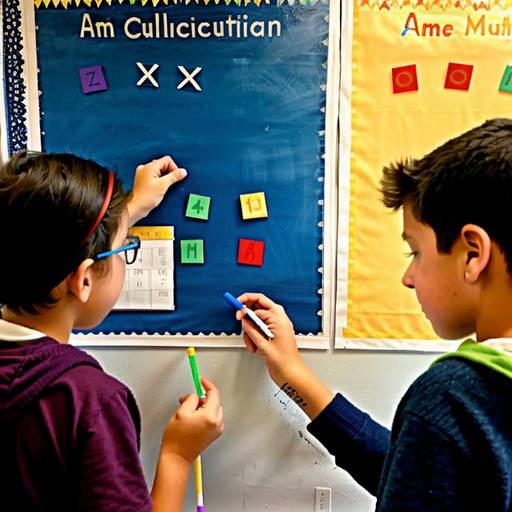
This 4th-grade math lesson focuses on helping students understand and apply the properties of multiplication, specifically the commutative, associative, and distributive properties. It begins with a class discussion about multiplication, followed by guided practice where students explore each property using manipulatives and examples. In small groups, students create posters to illustrate one property each, promoting creativity and collaboration. After group presentations, students work independently on a worksheet that reinforces the concepts learned, and teachers assess understanding through observation and review of completed assignments. The lesson concludes with a quick review and a homework assignment that encourages further practice. Differentiation strategies are included to support various learning needs, and extension activities offer opportunities for deeper exploration of multiplication in real-world contexts. Overall, the lesson aims to build confidence and proficiency in multiplication through engaging and interactive methods.

In this 4th-grade math lesson, students will explore multiplication and its key properties, specifically the commutative, associative, and distributive properties. The lesson begins with a review of multiplication concepts, followed by direct instruction where students engage with examples on the whiteboard.
Next, students work in small groups to create posters that illustrate one of the properties, promoting collaboration and creativity while reinforcing their understanding. The class then participates in a fun bingo game, where they solve multiplication problems and match their answers on bingo cards, enhancing engagement through friendly competition.
To solidify their learning, students will complete worksheets independently, applying the properties in various multiplication scenarios. The lesson concludes with a review of the concepts and an exit ticket activity to assess individual understanding. With differentiation strategies in place, the lesson accommodates various learning styles and paces, ensuring all students can grasp the essential principles of multiplication.