
Filters
Level
Grade
Subject
Subject Area
Subject Topic
Standard(s)
Audience
Keyword
DurationMinutes
3rd Grade Multiplication Lesson Plans


In this 3rd-grade mathematics lesson, students will explore the concept of multiplication as repeated addition and work on mastering the 2s, 5s, and 10s times tables. The lesson begins with a warm-up activity that reviews addition and introduces multiplication, demonstrating how to express repeated addition as multiplication.
Students will engage in interactive activities, including a flashcard quiz where they will test each other on multiplication facts, followed by a relay race that reinforces their skills through problem-solving at different stations. The class will then come together for a Times Table Challenge, where they will respond to multiplication questions, promoting memorization and understanding.
Throughout the lesson, teachers will assess student participation and comprehension, encouraging a positive learning environment. To conclude, students will reflect on effective strategies for remembering multiplication facts and receive stickers as rewards for their efforts. Overall, the lesson aims to build a strong foundation in multiplication through collaboration, movement, and fun activities.
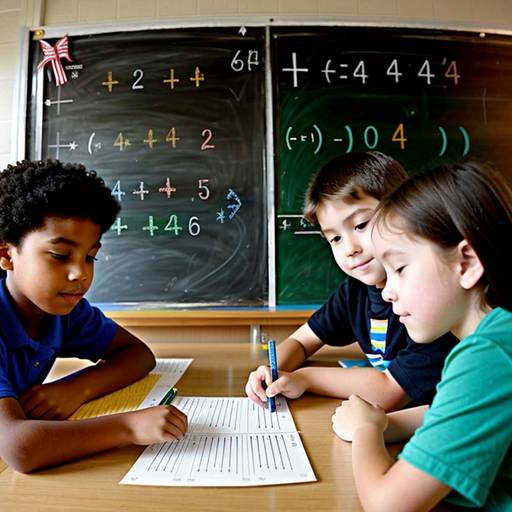
In this 3rd-grade math lesson plan, students will explore the concept of multiplication by understanding it as repeated addition through engaging activities. The lesson begins with a real-life scenario involving grouping objects to illustrate the basic idea of multiplication, followed by a clear explanation of key properties: Commutative, Associative, and Distributive.
Students engage in a group activity where they use manipulatives to create arrays that represent assigned multiplication problems, fostering collaborative learning and understanding of the properties. After this guided practice, students complete a worksheet independently, allowing them to apply what they've learned and draw arrays or groups to represent multiplication sentences.
The lesson concludes with a recap of the concepts discussed, encouraging students to share their insights. Assessment is conducted through observation during group activities and by reviewing worksheets for comprehension. Follow-up activities include a homework assignment where students create their own story problems using multiplication, reinforcing the lesson's objectives. Overall, this interactive approach aims to make multiplication enjoyable and accessible for young learners.

In this third-grade math lesson, students will explore multiplication through the context of word problems. The session begins with an engaging discussion about their experiences at markets or stores, leading to an introduction of multiplication as a shortcut for repeated addition. Key vocabulary associated with multiplication will be highlighted, along with essential keywords that signal multiplication in word problems.
During guided practice, students will work in pairs to collaboratively solve example problems, using counters for a visual representation of the concepts. This will encourage them to identify keywords and apply multiplication effectively. Following this, students will complete the "Mystery Market" Word Problem Worksheets independently, showcasing their understanding by solving various multiplication problems and explaining their reasoning.
The lesson concludes with a group review of selected problems, emphasizing the strategies used and allowing students to share insights. An exit ticket will prompt each student to create their own multiplication problem, providing a quick assessment of their comprehension. Accommodations will be made for diverse learners, ensuring all students are supported and challenged according to their individual needs. The overall goal is to strengthen students' multiplication skills while fostering critical thinking and problem-solving abilities.
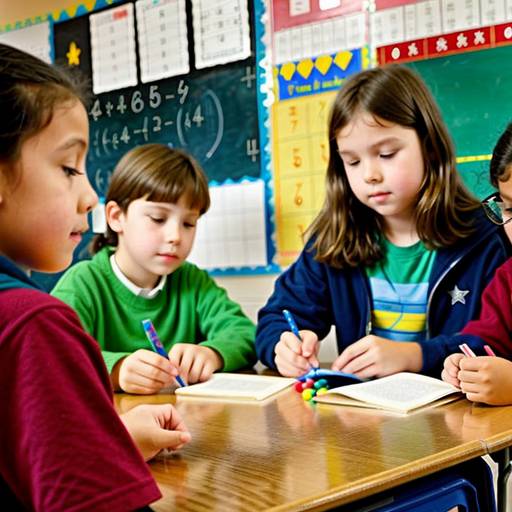
In this 3rd-grade math lesson, students will explore multiplication and practice their times tables through interactive activities. The lesson begins with a review of multiplication concepts and a demonstration of the times table on the whiteboard. Students will then engage in guided practice using flashcards to quiz one another, identifying which multiplication facts they find easiest and hardest.
The highlight of the lesson is a treasure hunt, where students work in pairs to solve multiplication problems on clue cards hidden around the classroom. Each correct answer leads them closer to a "treasure" of small prizes. After the treasure hunt, students will complete a worksheet with various multiplication problems for independent practice.
The lesson will conclude with a group discussion where students share their favorite parts and reflect on what they learned about multiplication. Assessment will be based on the completed worksheet and participation in activities, with adaptations available for varying skill levels. Extensions include creating a decorative multiplication chart to take home and exploring online multiplication games. This engaging approach to multiplication encourages collaboration and reinforces essential skills in a fun learning environment.