
Math Lesson Plan
Measuring Up Lesson Plan

Measuring Up

Exploring Weight and Measurement!

View Lesson

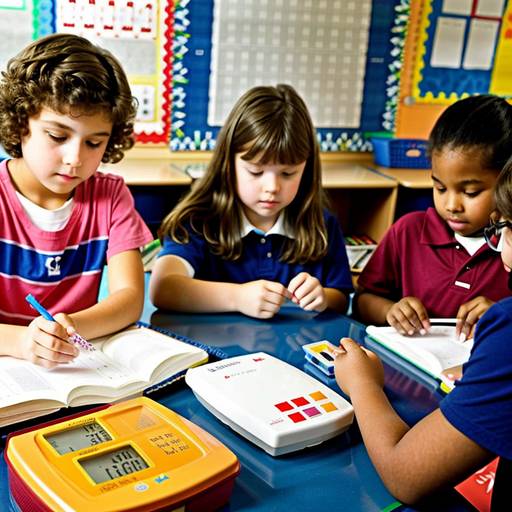
In this 4th-grade math lesson, students will explore the concepts of weight and measurement through engaging activities. The lesson begins with an introduction to the importance of measurement in everyday life and a discussion of weight, distinguishing between weight and mass. Students will learn to use digital and mechanical scales to weigh various objects and understand standard units of weight, specifically grams and kilograms. Guided practice involves small groups weighing selected objects and recording their weights, followed by converting between grams and kilograms.

For independent practice, students will complete a worksheet that includes comparison questions and conversion exercises. Closure involves a group discussion reflecting on the findings from the activities. Assessment will be based on observation during group tasks and review of completed worksheets. Extension activities, such as a scavenger hunt or a cooking project, further reinforce the skills learned. Accommodations will be provided to ensure all students can engage effectively in the lesson, culminating in a reflective evaluation of student performance for future improvements.

View Lesson

CCSS.4.MD.A.1
CCSS.4.MD.A.1
Know relative sizes of measurement units within one system of units including km, m, cm; kg, g; lb, oz.; l, ml; hr, min, sec. Within a single system of measurement, express measurements in a larger unit in terms of a smaller unit. Record measurement equivalents in a two-column table. For example, know that 1 ft is 12 times as long as 1 in. Express the length of a 4 ft snake as 48 in. Generate a conversion table for feet and inches listing the number pairs (1, 12), (2, 24), (3, 36), ...
CCSS.4.MD.A.2
CCSS.4.MD.A.2
Use the four operations to solve word problems involving distances, intervals of time, liquid volumes, masses of objects, and money, including problems involving simple fractions or decimals, and problems that require expressing measurements given in a larger unit in terms of a smaller unit. Represent measurement quantities using diagrams such as number line diagrams that feature a measurement scale.
CCSS.4.MD.A.3
CCSS.4.MD.A.3
Apply the area and perimeter formulas for rectangles in real world and mathematical problems. For example, find the width of a rectangular room given the area of the flooring and the length, by viewing the area formula as a multiplication equation with an unknown factor.
CCSS.4.MD.C.5
CCSS.4.MD.C.5
Recognize angles as geometric shapes that are formed wherever two rays share a common endpoint, and understand concepts of angle measurement:
CCSS.4.MD.C.5.a
CCSS.4.MD.C.5.a
An angle is measured with reference to a circle with its center at the common endpoint of the rays, by considering the fraction of the circular arc between the points where the two rays intersect the circle. An angle that turns through 1/360 of a circle is called a "one-degree angle," and can be used to measure angles.
CCSS.4.MD.C.5.b
CCSS.4.MD.C.5.b
An angle that turns through n one-degree angles is said to have an angle measure of n degrees.
LevelElementary School
Grade4th Grade
SubjectMath
Subject AreaMeasurement
Subject TopicWeight
Age Range9 to 10
AudienceGroup
LanguageEnglish
Duration60 mins