
Math Lesson Plan
Fraction Fun Lesson Plan

Fraction Fun

Discovering and Creating Equivalent Fractions!

View Lesson

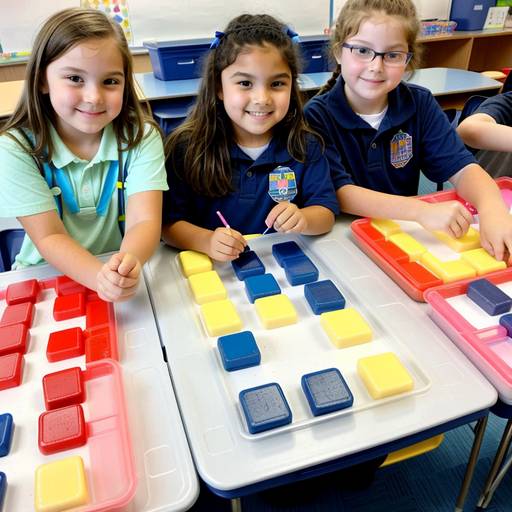
This lesson plan focuses on helping 4th-grade students understand fractions and identify equivalent fractions. The lesson begins with an engaging question about fractions using a relatable example, setting the stage for the learning objectives. Students are introduced to the basic concepts of fractions, including numerators and denominators, followed by an explanation of equivalent fractions with visual aids.

In the guided practice section, students create equivalent fractions using paper plates, allowing them to visually see and record their findings. An independent practice worksheet reinforces their understanding by challenging them to identify and create equivalent fractions on their own. The lesson concludes with a review of key concepts and an optional bingo game that serves as a fun way to assess their comprehension.

Extensions are provided for advanced learners, while additional support strategies are suggested for those who may struggle with the material. The teacher will reflect on the effectiveness of the lesson, considering student engagement and understanding for future improvements. Overall, the lesson integrates hands-on activities, visual aids, and collaborative learning to foster a solid grasp of fractions and equivalency.

View Lesson

CCSS.4.NF.A.1
CCSS.4.NF.A.1
Explain why a fraction a/b is equivalent to a fraction (n × a)/(n × b) by using visual fraction models, with attention to how the number and size of the parts differ even though the two fractions themselves are the same size. Use this principle to recognize and generate equivalent fractions.
CCSS.4.NF.A.2
CCSS.4.NF.A.2
Compare two fractions with different numerators and different denominators, e.g., by creating common denominators or numerators, or by comparing to a benchmark fraction such as 1/2. Recognize that comparisons are valid only when the two fractions refer to the same whole. Record the results of comparisons with symbols >, =, or <, and justify the conclusions, e.g., by using a visual fraction model.
CCSS.4.NF.B.3
CCSS.4.NF.B.3
Understand a fraction a/b with a > 1 as a sum of fractions 1/b.
CCSS.4.NF.B.3.a
CCSS.4.NF.B.3.a
Understand addition and subtraction of fractions as joining and separating parts referring to the same whole.
CCSS.4.NF.B.3.b
CCSS.4.NF.B.3.b
Decompose a fraction into a sum of fractions with the same denominator in more than one way, recording each decomposition by an equation. Justify decompositions, e.g., by using a visual fraction model. Examples: 3/8 = 1/8 + 1/8 + 1/8 ; 3/8 = 1/8 + 2/8 ; 2 1/8 = 1 + 1 + 1/8 = 8/8 + 8/8 + 1/8.
CCSS.4.NF.B.3.c
CCSS.4.NF.B.3.c
Add and subtract mixed numbers with like denominators, e.g., by replacing each mixed number with an equivalent fraction, and/or by using properties of operations and the relationship between addition and subtraction.
CCSS.4.NF.B.3.d
CCSS.4.NF.B.3.d
Solve word problems involving addition and subtraction of fractions referring to the same whole and having like denominators, e.g., by using visual fraction models and equations to represent the problem.
LevelElementary School
Grade4th Grade
SubjectMath
Subject AreaFractions
Subject TopicEquivalent Fractions
Age Range9 to 10
AudienceGroup
LanguageEnglish
Duration60 mins