
Filters
Level
Grade
Subject
Subject Area
Subject Topic
Standard(s)
Audience
Keyword
DurationMinutes
Preschool Light And Sound Lesson Plans

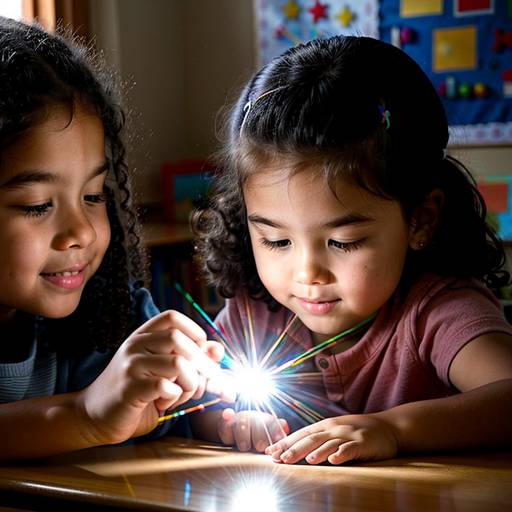
In this preschool science lesson, students will engage in hands-on exploration of the concepts of light and sound. The session begins with an introduction where students discuss their observations and experiences related to light and sound.
During the first activity, students work in small groups to discover shadow play using flashlights and cutout shapes, observing how shadows change with distance and angles. Following this, they experiment with colored cellophane overlays on flashlights to create colorful shadows, deepening their understanding of light properties.
The second part of the lesson focuses on sound exploration. Children experiment with various musical instruments and everyday objects to create sounds. They participate in a sound mystery box activity, allowing them to guess sounds based on their experiences.
The lesson concludes with a group discussion, where students reflect on their favorite activities and share what they learned about light and sound. Through creative exploration, observation, and interaction, students gain foundational knowledge of these sensory concepts while developing vocabulary and fostering curiosity.
This preschool science lesson focuses on the fundamental concepts of light and sound through interactive and hands-on activities. Designed for children aged 3-5, the lesson begins with a group discussion to introduce these sensory concepts, followed by engaging exploration stations. One set of stations allows children to experiment with light using flashlights, colored cellophane, and mirrors, while the other set focuses on sound with musical instruments and nature sound recordings. After each exploration, students gather to share their discoveries and reflect on their learning experiences. The lesson concludes with a story that reinforces the themes of light and sound. Throughout, teachers observe children's engagement and understanding while encouraging creative expression and reflection. Extension activities, such as creating a class mural or outdoor sound walks, provide additional opportunities for learning and exploration. Overall, this lesson fosters curiosity and a deeper understanding of the world through light and sound.
This preschool lesson plan focuses on exploring the concepts of light and sound through engaging, hands-on activities. The session begins with a group discussion about light and sound, using simple instruments and a flashlight to spark curiosity. Children then participate in a shadow play activity, where they use a flashlight to create and observe shadows formed by different objects. Following this, they explore sound by experimenting with various musical instruments, engaging in a "sound parade" to share what they create.
A reflective group discussion allows children to express their observations and experiences, enhancing their critical thinking skills. For those with extra time, an optional art activity encourages children to draw their interpretations of light and sound, fostering creativity. Throughout the lesson, assessment is based on participation, engagement, and understanding of the concepts discussed. This interactive approach helps young learners develop foundational scientific knowledge while enjoying the sensory experiences of light and sound.

This preschool science lesson focuses on exploring the concepts of light and sound through engaging, hands-on activities. Students will first discuss and share their prior knowledge about light and sound in a group setting. They will then participate in an activity using flashlights and colored translucent objects to observe how colors change and mix when light is shone through them.
Next, children will listen to various sounds, identifying and discussing their characteristics while also experimenting with small musical instruments to create their own rhythms.
The lesson will include a shadow exploration activity in a designated area, where students can use their hands and objects to create shadows, fostering an understanding of light’s properties. Students will then express their learnings through drawing, capturing their interpretations of light and sound.
The lesson concludes with a group discussion, allowing children to reflect on their experiences and articulate their favorite aspects of the activities. Throughout the lesson, informal assessments will be made through observations and discussions to gauge understanding and engagement. Extensions for continued exploration will also be suggested, such as creating a dedicated space for further light and sound activities or organizing a field trip to a science center.