
Filters
Level
Grade
Subject
Subject Area
Subject Topic
Standard(s)
Audience
Keyword
DurationMinutes
Preschool Spatial Awareness Lesson Plans

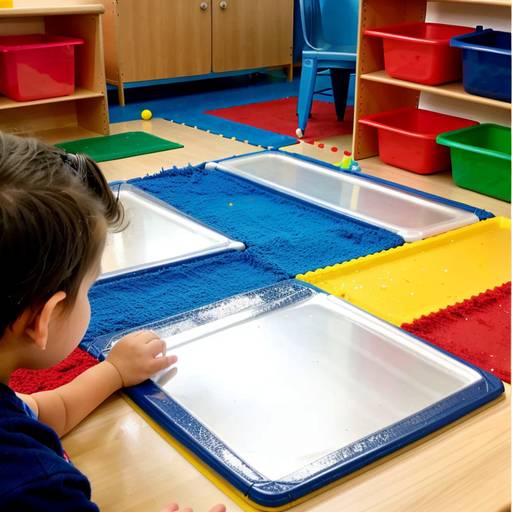
In this preschool lesson plan focused on spatial awareness, students engage in activities designed to enhance their understanding of positional concepts such as in, out, on, under, near, and far. The lesson begins with an interactive introduction using visual aids and gestures to explain these terms. Following this, students participate in storytime, listening to a book that highlights spatial relationships, accompanied by guided questions to foster comprehension.
The main activity involves rotating through various hands-on stations. At these stations, students engage in play and movement, using toys and hula hoops to explore and demonstrate spatial concepts physically. After the stations, there is a group discussion where students share their experiences and practice using the vocabulary learned.
To conclude, the lesson reinforces the spatial terms through a group chant or song, followed by a short assessment where students point out spatial concepts around them. The plan includes differentiation strategies to support diverse learning needs and suggests follow-up activities, such as worksheets and nature walks, to further explore spatial awareness in different contexts.
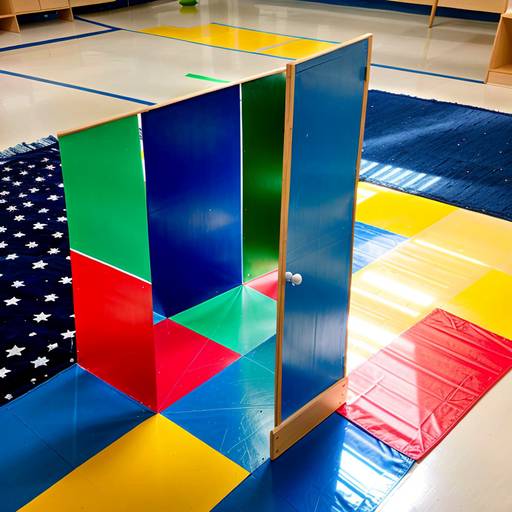
In this preschool lesson, students engage in a series of hands-on activities designed to enhance their spatial awareness skills. The session begins with an introduction to spatial concepts using picture cards, followed by an exploration of various-sized cardboard boxes where children can crawl, stand, and position themselves in relation to the boxes. Next, students navigate a maze created with colored tape or yarn, using directional language to describe their movements. Finally, they participate in a movement activity involving hula hoops, where they creatively move in different ways and describe their positions using spatial terminology. The lesson concludes with a reflection time for students to share what they learned, reinforcing key vocabulary and concepts. Through observation and participation, teachers assess students' understanding and encourage further development of these foundational skills in a playful and engaging environment.
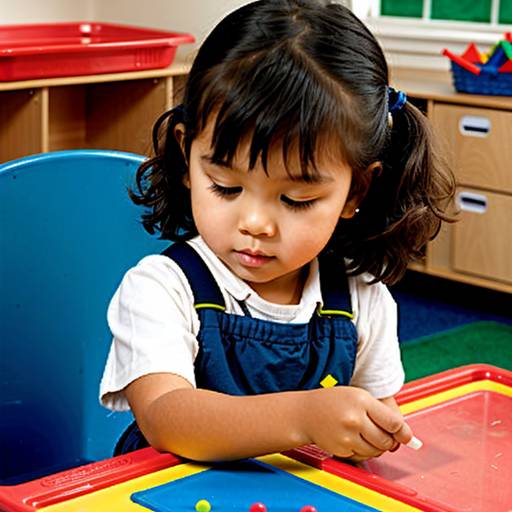
In this preschool lesson plan, children will engage in activities designed to enhance their understanding of spatial awareness through movement, play, and vocabulary development. The session begins with an introduction to basic spatial concepts such as above, below, in front of, behind, next to, and between, using visual aids like picture cards to facilitate comprehension.
Following the introduction, students participate in a dynamic movement activity where they follow verbal instructions related to spatial terms, enhancing their listening and physical coordination skills. Next, children work in small groups to build arrangements using blocks or toys, encouraging collaboration as well as an understanding of spatial relationships. Each group then presents their creations and describes their spatial configurations to their peers.
The lesson concludes with a closing circle discussion where children reflect on their favorite activities and learnings, reinforcing their grasp of spatial language. Throughout the session, various assessments will be made based on student participation, ability to follow instructions, and engagement with spatial concepts. Adaptations are provided for diverse learning needs, along with extensions to incorporate literature and scavenger hunts, ensuring a comprehensive and enjoyable learning experience that fosters both cognitive and social skills.
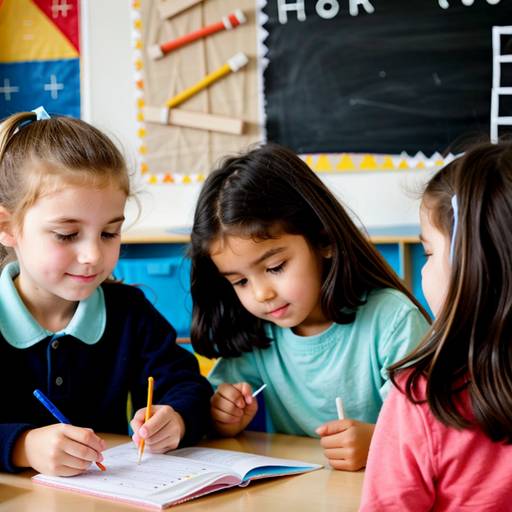
The lesson focuses on developing preschool students' spatial awareness skills through interactive activities that encourage the use of spatial vocabulary. Students will begin by discussing and demonstrating terms such as "above," "below," "next to," "in front of," and "behind." They will engage in a fun obstacle course designed to help them navigate their environment using these concepts.
Following the physical activity, students will create their own drawings of familiar spaces, labeling their artwork with the spatial vocabulary they learned. The lesson concludes with a group discussion to reinforce their understanding and encourage sharing. Throughout the activities, teachers will assess students' grasp of spatial relationships and their ability to communicate effectively. Adaptations are included to support varying skill levels and enhance engagement.