
Filters
Level
Grade
Subject
Subject Area
Subject Topic
Standard(s)
Audience
Keyword
DurationMinutes
Kindergarten Basics Lesson Plans

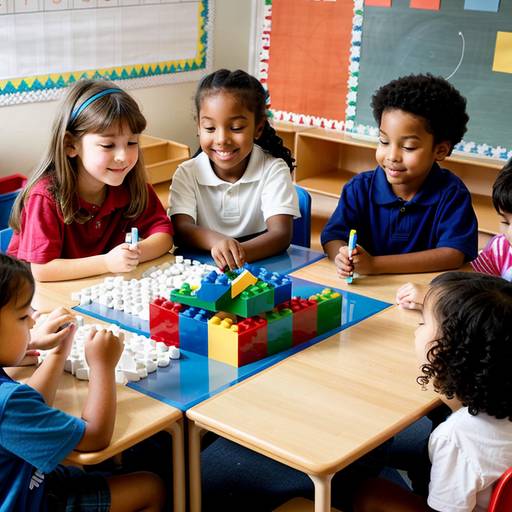
This Kindergarten math lesson focuses on introducing students to the concept of multiplication as repeated addition. The session begins with a warm-up activity that engages students in counting and creating groups with manipulatives, such as counting blocks. Through hands-on activities, students work in small groups to solve simple multiplication problems by visually representing them with blocks and drawings.
The lesson incorporates a storybook that reinforces the multiplication concept, encouraging students to identify groups within the narrative. After the group work, students complete a worksheet where they draw and solve multiplication problems visually.
The lesson concludes with students sharing their work with the class and participating in a fun game to reinforce their understanding. Assessment occurs through observation of group activities and review of worksheet answers, ensuring that students grasp the basic principles of multiplication in a concrete and engaging manner. Extensions for advanced learners are included to enhance their understanding further.
This Kindergarten math lesson focuses on introducing students to the concept of multiplication as repeated addition. It begins with a warm-up discussion about multiplication, followed by a read-aloud of a themed storybook that illustrates the concept. Through direct instruction, students learn to visualize multiplication with the help of counting blocks, making connections to addition.
In small groups, students participate in a hands-on activity where they represent different multiplication problems using blocks and share their findings with the class. This fosters teamwork and communication skills. After a collaborative presentation, students practice independently with worksheets that reinforce their understanding of multiplication through visual groupings. The lesson concludes with a reflective discussion about the importance and application of multiplication in real life.
Assessment is conducted through observation during group activities and the review of worksheets to ensure comprehension. Extensions and adaptations are available to further meet student needs and promote continuous learning. Overall, this lesson is designed to make multiplication engaging and accessible for young learners.

In this Kindergarten math lesson, students will explore the concept of multiplication through hands-on activities that emphasize grouping and repeated addition. The session begins with an engaging introduction to multiplication by using relatable examples, such as grouping objects to visualize the process. During guided practice, students will work with manipulatives to create and count groups, connecting their findings to multiplication sentences. For independent practice, they will use paper plates or containers to form their own groups and illustrate their understanding through drawings and labeling. The lesson concludes with a sharing session and optional storytelling, reinforcing their comprehension of multiplication. Assessment will occur through observation and review of students’ work, while accommodations and extensions are provided to support diverse learners and enhance engagement. Overall, this lesson fosters a foundational understanding of multiplication in a fun and interactive manner.
This Kindergarten math lesson focuses on introducing the concept of multiplication as repeated addition through hands-on activities and visual aids. The class begins with a warm-up counting song to activate prior knowledge. The teacher demonstrates multiplication using manipulatives, explaining the concept as "groups of" using simple examples. Students then participate in small group activities where they create their own multiplication problems with blocks or counters. Following group work, they complete worksheets that reinforce their understanding of matching groups to multiplication equations. The lesson concludes with a class discussion and exit tickets, allowing students to share real-world examples of multiplication they encounter. The assessment is based on informal observations and review of students' work, ensuring that each child grasps the foundational concept of multiplication. The lesson is designed to be interactive and engaging, catering to diverse learning styles through visuals, hands-on practice, and collaborative learning.