
Filters
Level
Grade
Subject
Subject Area
Subject Topic
Standard(s)
Audience
Keyword
DurationMinutes
Infant Turn Taking Lesson Plans

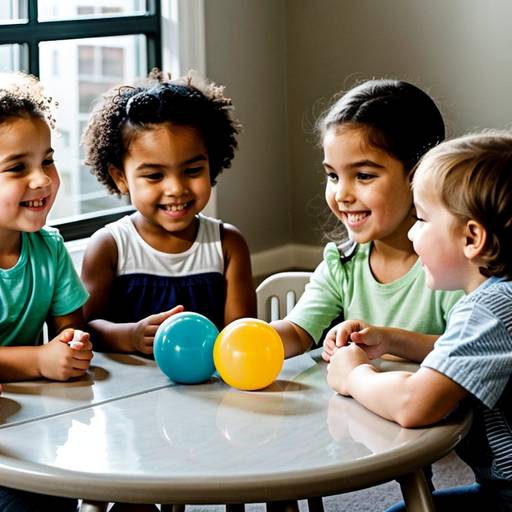
This lesson plan aims to teach infants aged 12-24 months the essential social skill of turn-taking through a series of interactive activities. The session begins with a welcome circle where the concept of sharing and taking turns is introduced, complemented by visual aids.
The first activity involves passing a soft ball around the circle, encouraging patience and participation as each child waits for their turn. This is followed by a musical instruments segment where infants take turns playing different instruments, reinforced by visual markers.
The next activity utilizes stacking blocks, emphasizing cooperative play as children add one block at a time in a turn-taking fashion. The lesson culminates in an interactive storytime, allowing each child to contribute by naming fruits, integrating both language skills and turn-taking.
Throughout the session, educators are advised to provide positive reinforcement, celebrating each child's participation and efforts while observing their social interactions. The goal is to foster communication, cooperation, and patience in a fun and engaging environment.
This lesson plan focuses on teaching infants the essential social skill of turn taking through a series of engaging activities. The objectives include fostering patience and cooperation among the children. The session begins with an introduction to the concept using a plush toy as a visual aid, followed by interactive circle time where visual aids depicting sharing are shown.
The main activity involves a structured toy time where infants take turns playing with various toys, utilizing a timer to regulate turns. A movement break with dance and music reinforces the joy of shared activities. The session concludes with a reflective circle where children discuss their favorite parts, followed by a short story that reinforces the theme of taking turns.
To support ongoing development, follow-up activities are suggested, allowing children to practice turn taking in a variety of contexts. Throughout the lesson, opportunities for assessment and positive reinforcement are given to help encourage successful interactions.
The lesson plan aims to teach infants the concept of turn taking through engaging activities and interactive play. It begins with a lively introduction that includes a song to gather the group and a simple explanation of sharing. A storytelling session using colorful picture cards illustrates characters taking turns, fostering comprehension.
Two main activities follow: the first involves small groups of infants engaging with toys, learning to play and wait for their turn with guidance. The second activity incorporates music and movement, where infants dance and practice stopping to take turns. An optional snack-sharing segment encourages further practice of turn taking and encourages communication through verbal prompts.
The session concludes with a closing circle, where infants can share their favorite moments, reinforcing their learning. Throughout the lesson, caregivers are encouraged to observe and continue practicing turn taking at home, ensuring the development of these important social skills in everyday situations.
This lesson plan focuses on helping infants develop fundamental social skills related to turn-taking through interactive play. It is designed for a group of infants aged 6 to 18 months and spans 30-45 minutes. The session begins with a brief introduction that includes modeling turn-taking using a soft toy to illustrate the concept.
The main activity involves distributing soft toys or balls to each child, where they practice passing the items around while using a timer to facilitate sharing. This encourages both patience and cooperation. Additionally, simple turn-taking games using picture cards are incorporated to visually reinforce the skill in various contexts.
A transition activity features gentle music to promote movement and joy, while the conclusion features a discussion with caregivers about the importance of turn-taking, followed by a closing song or rhyme. Observations during the activities help assess children’s participation and reactions. The lesson encourages caregivers to reinforce the skill at home through playful interactions, promoting ongoing development of social skills. Overall, the plan creates a fun, engaging environment for infants to learn and practice sharing and cooperation with their peers.