
Filters
Level
Grade
Subject
Subject Area
Subject Topic
Standard(s)
Audience
Keyword
DurationMinutes
5th Grade Motion Lesson Plans

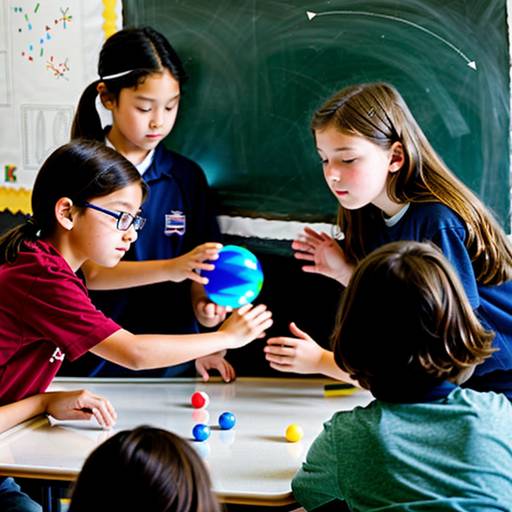
In this physical science lesson for 5th graders, students will explore the concepts of motion and the forces that influence it. The lesson begins with an engaging discussion about motion, during which students will share their prior knowledge and learn key vocabulary such as force, gravity, friction, and acceleration. Following direct instruction that includes visual aids and diagrams, the class will break into small groups to conduct a hands-on experiment. Each group will use toy cars, ramps, and weights to investigate how different weights affect the speed and distance traveled by the cars. Students will record their observations in journals and participate in a class discussion to share their findings and insights.
The lesson aims to provide students with a foundational understanding of how forces interact with motion, emphasizing the relationship between weight, friction, and movement. Assessment will focus on student engagement during the activities and their journal entries, with opportunities for further exploration or reinforcement based on individual student needs. Through this interactive approach, students will gain a deeper appreciation of the principles of physics in their everyday lives.
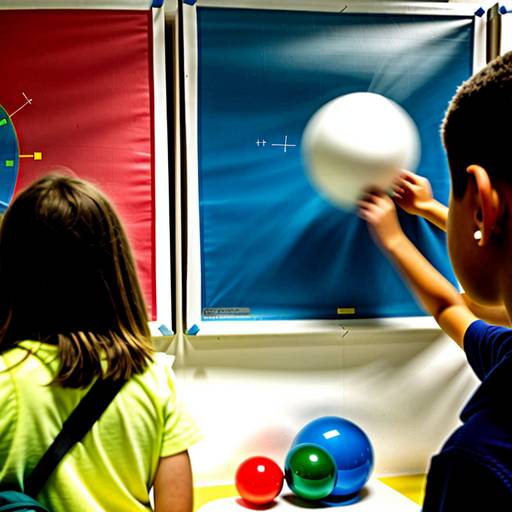
In this 5th-grade science lesson focused on physical science and motion, students will explore essential concepts such as speed, direction, force, and gravity through hands-on activities. The lesson begins with a discussion to engage students and introduce key terminology. In the first activity, small groups will conduct experiments with toy cars or balls on a ramp, measuring their speed and distance. They will perform multiple trials to gather data, fostering observation and discussion about how various factors influence motion.
The second activity will involve adding weights to the cars or balls, allowing students to investigate how additional force impacts movement, speed, and distance. After completing both activities, groups will present their findings, followed by a reflective writing exercise in their science journals to cement their understanding. The lesson will include assessments based on group discussions, data collection, and reflective writing. Extensions may include research on notable scientists related to motion or a day dedicated to testing different movements. Ultimately, students will gain a fundamental understanding of how forces affect motion through active engagement and experimentation.
This 5th-grade physical science lesson focuses on the concepts of motion and forces. Students begin by discussing their observations of movement in everyday life and learn key terms such as motion, force, and friction. The lesson includes direct instruction on how motion is defined and measured and how different forces influence an object's speed and direction.
In small groups, students conduct hands-on experiments using toy cars, ramps, and weights to explore how various factors, such as mass and height, affect motion. They measure the distance and time taken for cars to travel down ramps, recording their findings.
After the experiments, students engage in a guided class discussion to share their observations and analyze the impact of forces on motion, encouraging critical thinking about real-world applications. The lesson concludes with a reflection assignment, prompting students to connect the concepts of motion and forces to their own experiences. Overall, this interactive lesson provides an engaging way for students to grasp fundamental physical science principles.
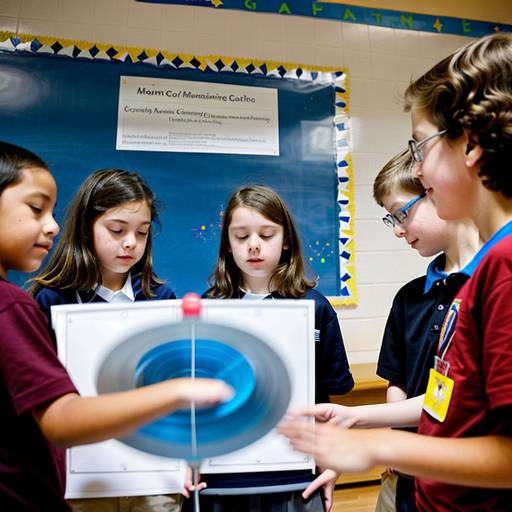
This fifth-grade science lesson focuses on understanding the concepts of motion and forces. Students will learn about different types of forces, including gravity, friction, pushes, and pulls, and explore how these forces affect the movement of objects.
The lesson begins with an engaging discussion to activate prior knowledge, followed by a direct instruction segment that provides definitions and examples of key concepts. Students will then participate in a hands-on experiment where they will work in small groups to test how varying ramp heights and surfaces influence the distance a toy car travels. They will record their observations on worksheets and engage in discussions to analyze their findings.
Finally, groups will present their results to the class, reinforcing their understanding of the impact of forces on motion. Assessment will be based on the collected worksheets and group presentations. The lesson encourages collaboration and critical thinking, with opportunities for extension activities that promote further exploration of the topic.