
Filters
Level
Grade
Subject
Subject Area
Subject Topic
Standard(s)
Audience
Keyword
DurationMinutes
5th Grade Solids Lesson Plans

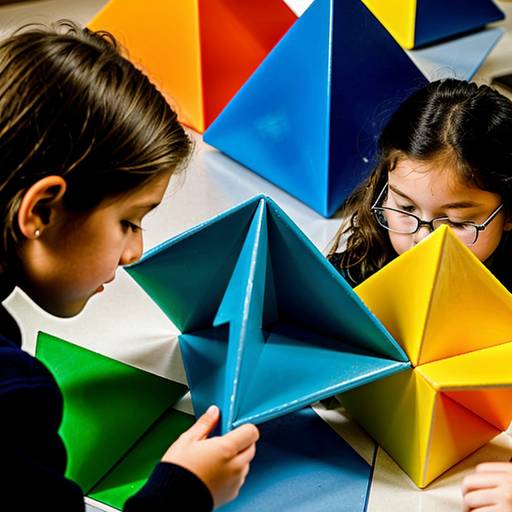
This lesson plan focuses on introducing 5th-grade students to three-dimensional geometric shapes and their properties. The session begins with a discussion about 3D shapes encountered in daily life, using physical models or pictures for visual aid. Students learn to identify different 3D shapes, such as cubes, prisms, and cones, while exploring their characteristics, including faces, edges, and vertices.
In guided practice, students work in small groups to classify shapes based on their properties and share their findings with the class. The hands-on activity allows students to create their own 3D shapes using colored paper, scissors, and glue, reinforcing their understanding of the properties while fostering creativity.
The lesson concludes with a discussion on the presence of 3D shapes in architecture and nature, encouraging students to reflect on their learning. Assessment is based on participation, accuracy in worksheets, and the completed shape project. Follow-up activities may include creating collages of 3D shapes found in their environments and exploring geometry through technology. Overall, the lesson aims to deepen students' understanding of geometry in an engaging and interactive manner.
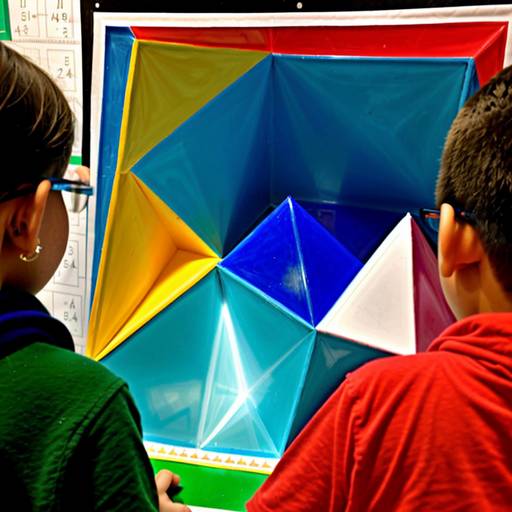
In this 5th-grade math lesson, students will explore essential concepts related to 3D geometry, focusing on identifying and describing common solid shapes, including cubes, spheres, cylinders, cones, and pyramids. The lesson begins with a discussion about geometry and its relevance in everyday life, followed by an introduction to the properties of these shapes. Through a shape hunt activity, students will find real-world objects that correspond to the identified 3D shapes and share their findings with classmates. They will then engage in a hands-on activity to create their own 3D models, labeling their properties. The lesson concludes with presentations of their creations, emphasizing the importance of recognizing shapes in their environment. Assessment will be based on participation, accuracy in labeling, and worksheet completion. Extension activities are suggested for students who excel, including lessons on volume and surface area, as well as research on notable structures. Overall, the lesson promotes active learning and fosters a deeper understanding of geometric concepts in a relatable manner.