
Filters
Level
Grade
Subject
Subject Area
Subject Topic
Standard(s)
Audience
Keyword
DurationMinutes
5th Grade Narrative Writing Lesson Plans


In this 60-minute lesson, 5th-grade students will explore the key elements of narrative writing, including characters, setting, plot, conflict, and resolution. The session begins with a discussion about what makes stories interesting, which will be recorded on a whiteboard. After introducing the key narrative elements with examples, students will engage in guided practice by working in small groups to create a story map based on a familiar tale. Each group will present their story map to the class, reinforcing their understanding of narrative structure.
Following this collaborative activity, students will brainstorm and outline their own narrative ideas using provided prompts, focusing on developing their main character, setting, conflict, and resolution. They will then draft their narratives, incorporating descriptive language and dialogue. The lesson concludes with students sharing portions of their stories with the class, helping to foster a sense of community and encouraging creativity.
Assessment will be carried out by collecting outlines and narrative drafts to evaluate students' comprehension of narrative structure and their writing skills. Extensions and differentiation strategies are included to cater to varied learning needs, ensuring all students can engage meaningfully with the writing process.
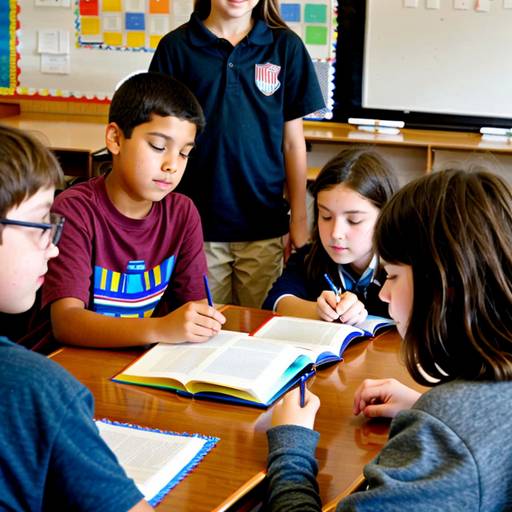
In this 5th-grade language arts lesson, students will explore narrative writing by creating their own imaginative stories. The lesson begins with a discussion about the elements of narratives, including characters, setting, plot, conflict, and resolution. Following this, a mini-lesson on descriptive language emphasizes its importance in enhancing storytelling by helping readers visualize and connect with the narrative.
Students will then brainstorm their story ideas using graphic organizers to outline key components. With ample writing time, they will compose their narratives, applying learned techniques, while utilizing a checklist to ensure they include all necessary elements. Afterward, students will share portions of their stories with peers for feedback, fostering a collaborative learning environment.
The lesson concludes with a reflection on what they learned about narrative writing and the significance of detail in storytelling. Assessments will focus on participation during discussions and the completeness and creativity of their narratives. Differentiation strategies will be employed to support diverse learners, with opportunities for extension activities, such as illustrating scenes from their stories.