
Filters
Level
Grade
Subject
Subject Area
Subject Topic
Standard(s)
Audience
Keyword
DurationMinutes
5th Grade Reading Strategies Lesson Plans


This lesson plan focuses on teaching fifth-grade students effective reading strategies to enhance their comprehension and engagement with texts. The objectives include familiarizing students with four key strategies: predicting, questioning, summarizing, and visualizing. The lesson starts with a discussion on the importance of reading and a modeling session where the teacher demonstrates each strategy using a selected passage.
Following this, students engage in guided practice by forming small groups to read a short story together and create mini-posters summarizing how they applied the strategies. For independent practice, students choose their own chapter book or story to read, applying at least three of the strategies while taking notes. The class concludes with a sharing session, where students reflect on their experiences with the strategies. Assessment is mostly informal through participation, group work, and students’ notes, with a potential exit ticket to gauge individual understanding.
The lesson emphasizes building strong reading habits and the importance of using multiple strategies to become more effective readers.
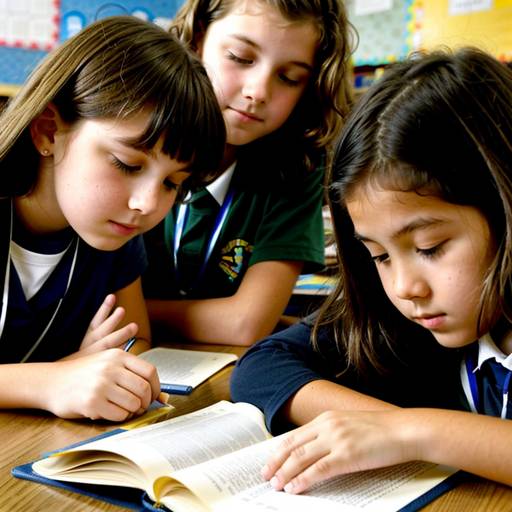
In this 5th-grade Language Arts lesson, students focus on identifying and summarizing the main ideas and supporting details of a text. The lesson begins with a discussion on the importance of understanding the main idea, followed by the introduction of key vocabulary such as "main idea" and "supporting details." Students engage in a guided practice where they work in small groups to analyze a shared passage and fill out a graphic organizer with their findings. Each group then presents their main idea and supporting details to the class. In the independent practice section, students read a different passage on their own and complete their own graphic organizer, utilizing a reading strategy bookmark for support. The lesson concludes with a class sharing activity where students summarize their insights on post-it notes, reinforcing their understanding of the concepts learned. Assessments are based on the graphic organizers, group participation, and the clarity of the post-it note summaries. Extensions and adaptations are provided to cater to varying student needs and abilities.

In this 5th Grade Language Arts lesson plan, students will explore the important role of characters in a story. The lesson begins with a discussion about memorable characters and their influence on narratives. Following an engaging read-aloud of a selected short story, students will collaborate in pairs to complete character trait charts, identifying traits, motivations, and actions of the main character(s). To deepen their understanding, students will also make personal connections by reflecting on their own experiences related to a character's traits, which they will write about on post-it notes. The class will reconvene for a discussion to share insights gained from their analysis and connections. Assessment will focus on participation, completion of charts, and the personal reflection writing. Extensions and modifications are included to support diverse learning needs, providing opportunities for further engagement with character analysis and reading comprehension.

This 5th-grade Language Arts lesson focuses on enhancing students' reading comprehension through the identification of key story elements and the application of effective reading strategies. The lesson begins with a discussion about the components of a good story, such as setting, characters, plot, conflict, and resolution. Students are introduced to four reading strategies: making predictions, visualizing, questioning, and summarizing.
In a guided reading section, the class reads an adapted short story together while engaging with the text using the strategies introduced. As they read, students take notes on sticky notes to capture their thoughts and questions. Following the reading, students work in small groups to complete graphic organizers, known as story maps, where they identify the story elements and summarize their understanding. The lesson culminates in a class discussion where groups share their insights and reflect on how the strategies aided their comprehension.
Assessment includes observing participation, reviewing story maps, and collecting exit tickets in which students summarize what they learned about the reading strategies. Extensions encourage students to apply the strategies to their own book selections at home and create short stories to reinforce the lesson’s concepts. The lesson emphasizes student engagement and interaction, fostering critical thinking skills and a deeper understanding of narrative structure.