
Filters
Level
Grade
Subject
Subject Area
Subject Topic
Standard(s)
Audience
Keyword
DurationMinutes
4th Grade Solids Lesson Plans

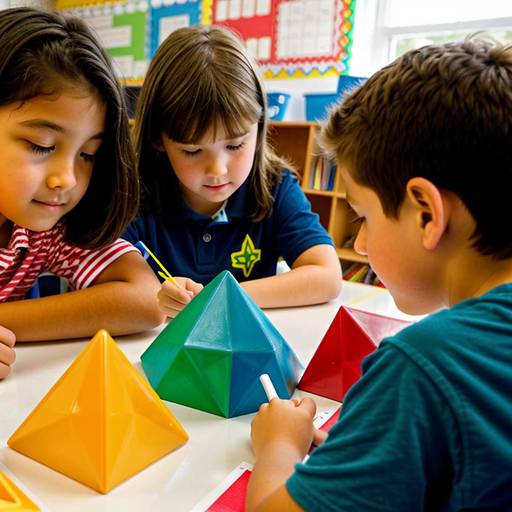
In this 4th-grade math lesson, students will explore the concept of three-dimensional shapes by identifying, analyzing, and creating various solids such as cubes, spheres, cylinders, cones, and pyramids. The lesson begins with a discussion about the shapes found in everyday life, followed by a mini-lecture that highlights the properties of each solid, including the number of faces, edges, and vertices.
Students engage in a scavenger hunt to find real-world examples of 3D shapes, promoting active learning and exploration. They then create their own models using construction paper, applying their understanding of shape properties. The lesson concludes with student presentations, where they share their models and reflect on the applications of these shapes in real life. Assessment will include observation during activities, the evaluation of models, and a quiz on identifying and describing 3D shapes. Differentiation strategies are included to support all learners, and extension activities provide opportunities for deeper exploration.
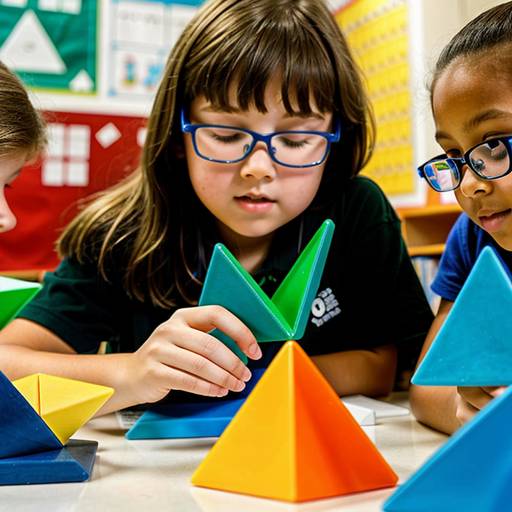
This 4th-grade math lesson focuses on introducing students to three-dimensional shapes and their properties. The lesson begins with a discussion on real-life examples of 3D shapes, followed by a presentation on various solids, including cubes, spheres, cylinders, cones, and pyramids. Students will engage in hands-on activities to examine and classify these shapes while counting their faces, edges, and vertices.
In small groups, they will work on worksheets to identify and classify different 3D shapes, reinforcing their understanding through collaboration. Students will then create their own 3D shapes on graph paper, labeling their properties. At the end of the lesson, there will be a review of key concepts and a homework assignment that encourages students to find and document examples of 3D shapes in their environment.
Assessment will be conducted through observation during activities and the evaluation of worksheets and homework for comprehension. Differentiation strategies will be employed to support all learners, including extensions for advanced students, and additional guidance for those needing extra help. Overall, the lesson aims to make learning about geometry engaging and relevant to students’ everyday lives.