
Filters
Level
Grade
Subject
Subject Area
Subject Topic
Standard(s)
Audience
Keyword
DurationMinutes
4th Grade Solids Lesson Plans

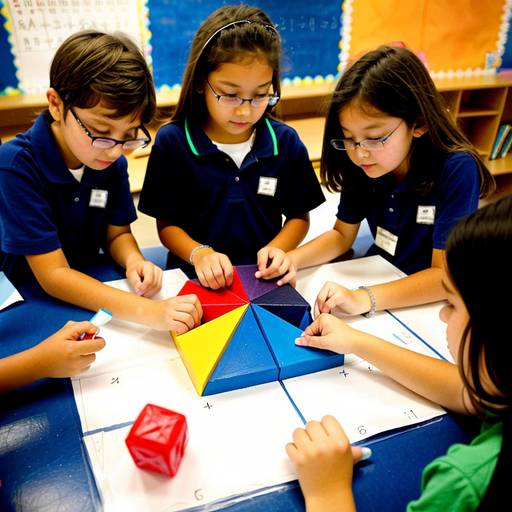
This 4th-grade math lesson focuses on identifying and describing three-dimensional shapes, including cubes, spheres, cylinders, cones, and pyramids. The lesson begins with an engaging discussion about shapes found in the students’ environment, followed by direct interaction with geometric solids in small groups. Students will explore the properties of these shapes by counting edges, vertices, and faces and will create visual charts to support their findings.
After presenting their charts to the class, students will participate in a scavenger hunt around the classroom or school to find real-world examples of the shapes learned. The lesson concludes with a worksheet assessment that tests their understanding of the concepts introduced.
Throughout the session, there are opportunities for differentiation to meet the diverse needs of learners, and extensions are suggested to engage students further. Overall, the lesson combines hands-on activities, collaborative learning, and real-life applications to help students grasp the essentials of 3D geometry comprehensively.
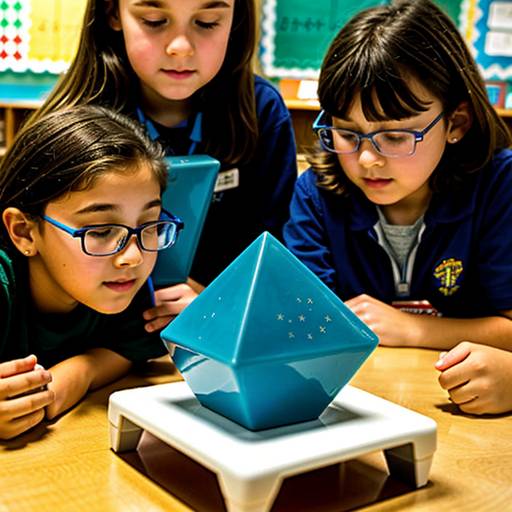
This lesson plan focuses on introducing 4th-grade students to three-dimensional shapes, or solids, emphasizing their properties, classifications, and real-world applications. The session begins with an engaging discussion about 3D shapes, where students identify various examples and learn about their characteristics, including faces, edges, and vertices.
Following the introductory discussion, students participate in a shape sorting activity in small groups, using manipulatives to categorize the solids and share their findings with the class. The lesson continues with a creative component in which each student designs their own unique solid, labeling its properties and dimensions, and then shares their creation with a partner.
To conclude, the class reflects on what they learned throughout the lesson, discussing interesting aspects of the solids they created and their practical applications. Assessment is conducted through observations, reviewing shape sorting mats, and evaluating students' designs based on clarity and accuracy. Extensions to the lesson encourage further exploration of real-world applications of solid shapes and introduce basic volume concepts if time permits. Overall, this lesson promotes hands-on learning, creativity, and collaborative engagement among students.