
Filters
Level
Grade
Subject
Subject Area
Subject Topic
Standard(s)
Audience
Keyword
DurationMinutes
4th Grade Vocabulary Lesson Plans


This 4th-grade Language Arts lesson focuses on enhancing students' vocabulary through engaging activities and collaborative learning. The class begins with an interactive word game to capture students' interest, followed by the introduction of 10 target vocabulary words. In small groups, students explore assigned words by brainstorming definitions, synonyms, antonyms, and creating sentences, which encourages teamwork and critical thinking.
After a read-aloud of a short story that incorporates the vocabulary words, students discuss context clues and share sentences from the text. Each student then records the vocabulary words in their personal journals, detailing definitions, illustrations, and sentences, reinforcing their understanding.
The lesson includes interactive games, such as charades or Pictionary, to provide a dynamic way for students to practice the vocabulary. Students reflect on their learning by sharing their favorite new word and its significance. To promote continuous vocabulary development, they are encouraged to seek and document new words throughout the week for a shared "Vocabulary Treasure Chest." Assessment is based on participation, journal entries, and engagement in activities. Adaptations are provided for different learning needs, ensuring all students can participate meaningfully.

In this 4th-grade Language Arts lesson, students will engage in a vocabulary exploration activity designed to enhance their understanding and application of new words. The lesson begins with a discussion about the significance of vocabulary, followed by an introduction of ten new words. Students will work in small groups to investigate the meanings of assigned vocabulary words, creating visual aids that include definitions, example sentences, and illustrations.
Next, students will complete individual "treasure maps," where they will creatively respond to prompts related to each vocabulary word, reinforcing their learning through drawing and writing. The lesson culminates with students sharing their maps and favorite words with partners and the class. Overall, the lesson encourages collaboration, creativity, and contextual word usage, while providing opportunities for assessment through observation and review of student work. Extensions include keeping a vocabulary journal and planning a scavenger hunt to further reinforce vocabulary skills.
Following this, a mini-lesson on using context clues will help students learn how to deduce the meanings of unfamiliar words within sentences, allowing them to practice this skill through guided exercises. To apply their new knowledge, students will write sentences using the vocabulary words and share them with partners.
The lesson concludes with a reflection on the importance of a strong vocabulary, assigning students to read a short story, identify new words, and create a vocabulary web for each. Assessment will involve monitoring participation, reviewing group work and individual worksheets for understanding, and observing students’ use of new vocabulary. Extensions and accommodations will further support student engagement and individual learning needs.
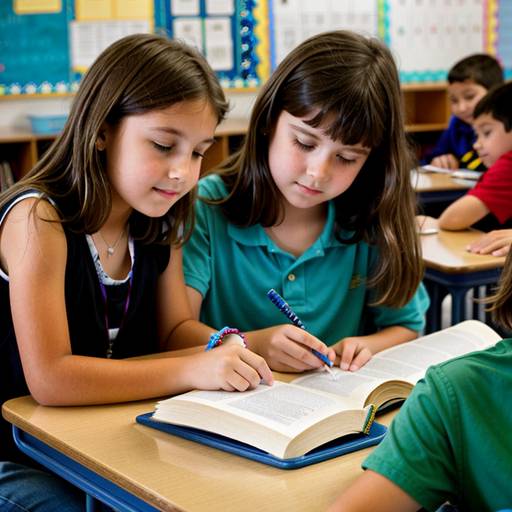
In this 4th-grade language arts lesson, students will enhance their vocabulary skills through various engaging activities. The lesson begins with a discussion on the importance of vocabulary, followed by the introduction of 10 new words related to a recently read text. Students will work in pairs to explore these words using a thesaurus to find synonyms and antonyms and create sentences demonstrating their understanding.
Next, they will engage in a context clue activity where they fill in the blanks of sentences with the vocabulary words, using context clues to infer meanings. This will be followed by a creative project where pairs create a mini poster for one selected vocabulary word, including its definition, synonyms, antonyms, and an illustration. Presentations of these posters will allow students to share their creativity and understanding with the class.
The lesson will conclude with a recap of the day’s activities, emphasizing the role of vocabulary in communication and comprehension. As homework, students will complete a treasure hunt worksheet, finding and defining five new words from their reading at home. Assessments will focus on participation, the completion of worksheets, and the creativity of the posters, with differentiation strategies in place to support diverse learners.