
Filters
Level
Grade
Subject
Subject Area
Subject Topic
Standard(s)
Audience
Keyword
DurationMinutes
3rd Grade Landforms Lesson Plans

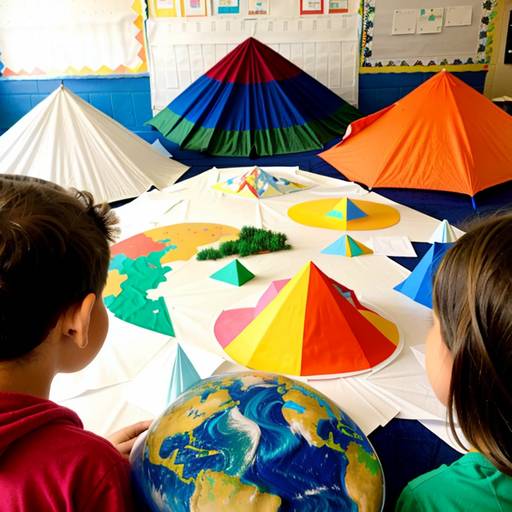
This lesson plan for 3rd graders focuses on geography and landforms, aiming to help students identify and understand various types of landforms, including mountains, valleys, plains, and rivers. The lesson begins with an interactive discussion about geography, where students share what they know about landforms. It then includes a presentation that defines each landform and discusses its importance to the environment and human life.
Students engage in a hands-on activity where they create their own maps using colored pencils to illustrate different landforms creatively. They work in small groups matching flashcards with definitions and pictures, reinforcing their learning through collaboration. The lesson concludes with a fun game of “Landform Bingo,” allowing students to test their knowledge in an engaging way.
Assessment is conducted through observation during activities and the evaluation of completed maps. To extend learning beyond the classroom, students are assigned a homework task to find pictures of landforms to share with their peers in the next session. Overall, the lesson promotes active participation, teamwork, and creativity while deepening students' understanding of landforms and their significance.
In this 3rd-grade social studies lesson, students will explore various landforms, including mountains, valleys, hills, plateaus, and plains. The lesson begins with an engaging discussion that prompts students to share their prior knowledge about these geographic features. Throughout the lesson, the teacher will introduce each landform through images and descriptions, encouraging students to relate them to local examples.
Students will then participate in a hands-on project where they work in small groups to create models of assigned landforms using clay or playdough. This activity not only promotes teamwork but also allows students to physically represent the characteristics of each landform. After completing their models, groups will present their creations to the class, detailing their landform’s features and significance.
The lesson concludes with a review of the key concepts learned, followed by a reflective discussion about the importance of landforms in shaping human life and the environment. Students will complete an exit ticket activity that reinforces their understanding by matching landforms with pictures and writing down a fact they learned. Assessment will be based on participation, creativity in the project, and comprehension demonstrated in the exit ticket. Opportunities for extension are provided for those who want to delve deeper into famous landforms around the world.
In this engaging third-grade social studies lesson, students will explore various landforms and their characteristics, understanding how they shape the Earth and influence human activities. The lesson begins with a discussion to elicit prior knowledge about Earth's surface, followed by a presentation featuring visual aids that describe different landforms, such as mountains, valleys, and rivers. Students will work in small groups to research a specific landform and share their findings with the class. Each student will then create a colorful map illustrating at least three different landforms, promoting creativity and individual expression. The class will participate in a gallery walk to showcase their maps, followed by a group discussion on their favorite landforms and their significance. To assess understanding, students will complete a worksheet that includes matching landforms with definitions and discussing their importance in everyday life. The lesson includes adaptations to support various learning needs and concludes with a reflective component to reinforce their learning experience.