

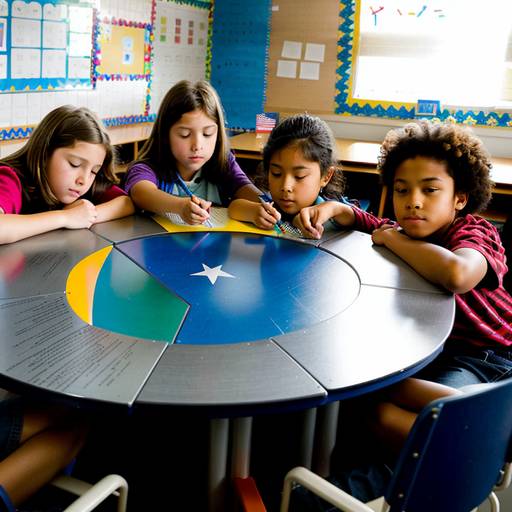
This 4th-grade science lesson focuses on helping students understand the fundamental concepts of forces and energy, specifically kinetic and potential energy, and their relation to motion. The lesson begins with an engaging discussion to elicit student ideas about how objects move. Through direct instruction, students learn about the definitions and real-life examples of kinetic and potential energy, as well as the role of forces like gravity.
Students participate in a hands-on experimentation activity in small groups, where they use toy cars, wooden ramps, and weights to explore how varying ramp heights and added weights affect motion and energy. They record their observations on worksheets to reinforce their understanding. The class reconvenes to share findings and discuss important concepts, solidifying their comprehension through collaborative learning.
The lesson concludes with a recap of the key concepts, encouraging students to identify examples of potential and kinetic energy in their everyday lives, as well as discussing the impact of forces on those energies. Assessment is based on worksheet completion and participation in discussions and activities, with extensions available for advanced learners to explore further connections to energy transformations and simple machines. This lesson aligns with Next Generation Science Standards and fosters an engaging and interactive learning environment.
| Level | Elementary School |
| Grade | 4th Grade |
| Subject | Science |
| Subject Area | Physical Science |
| Subject Topic | Energy |
| Age Range | 9 to 10 |
| Audience | Group |
| Language | English |
| Duration | 60 mins |