
Math Lesson Plan
Fraction Fiesta Lesson Plan

Fraction Fiesta

Solving Everyday Challenges with Fractions!

View Lesson

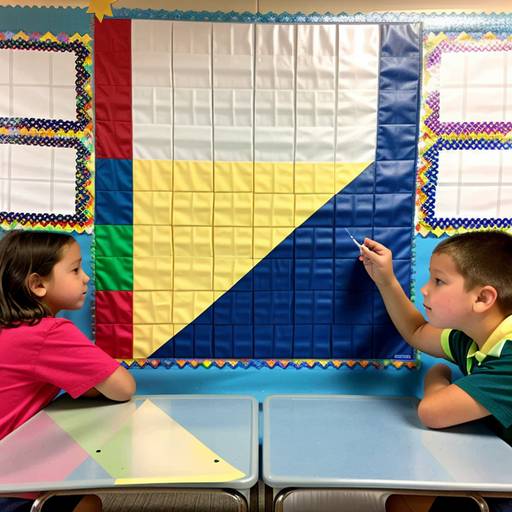
In this 5th-grade math lesson focused on fractions and fraction word problems, students will gain a solid understanding of fractions, including the roles of numerators and denominators, and how fractions apply to real-life situations. The lesson begins with a review of fractions and a discussion about their everyday use. Next, students will learn a step-by-step approach to solving fraction word problems through direct instruction, which includes a modeled example for the class to solve together.

During guided practice, students will work in small groups to tackle assigned fraction word problems from "Fraction Fiesta Challenge" cards, fostering collaboration and communication. Following this, students will engage in independent practice with worksheets that present additional fraction word problems to enhance their problem-solving skills.

The session concludes with a sharing opportunity, where groups present their solutions, reinforcing the learning objectives. Students’ understanding will be assessed through their participation, worksheet accuracy, and explanation of their problem-solving processes. Differentiation strategies will be employed to support diverse learners, ensuring all students are engaged and challenged appropriately. As a follow-up, families will be encouraged to explore cooking with fractions and students will have the chance to create and share their own original fraction word problems.

View Lesson

CCSS.5.NF.A.1
CCSS.5.NF.A.1
Add and subtract fractions with unlike denominators (including mixed numbers) by replacing given fractions with equivalent fractions in such a way as to produce an equivalent sum or difference of fractions with like denominators. For example, 2/3 + 5/4 = 8/12 + 15/12 = 23/12. (In general, a/b + c/d = (ad + bc)/bd.)
CCSS.5.NF.A.2
CCSS.5.NF.A.2
Solve word problems involving addition and subtraction of fractions referring to the same whole, including cases of unlike denominators, e.g., by using visual fraction models or equations to represent the problem. Use benchmark fractions and number sense of fractions to estimate mentally and assess the reasonableness of answers. For example, recognize an incorrect result 2/5 + 1/2 = 3/7, by observing that 3/7 < 1/2.
CCSS.5.NF.B.3
CCSS.5.NF.B.3
Interpret a fraction as division of the numerator by the denominator (a/b = a ÷ b). Solve word problems involving division of whole numbers leading to answers in the form of fractions or mixed numbers, e.g., by using visual fraction models or equations to represent the problem. For example, interpret 3/4 as the result of dividing 3 by 4, noting that 3/4 multiplied by 4 equals 3, and that when 3 wholes are shared equally among 4 people each person has a share of size 3/4. If 9 people want to share a 50-pound sack of rice equally by weight, how many pounds of rice should each person get? Between what two whole numbers does your answer lie?
CCSS.5.NF.B.4
CCSS.5.NF.B.4
Apply and extend previous understandings of multiplication to multiply a fraction or whole number by a fraction.
CCSS.5.NF.B.5
CCSS.5.NF.B.5
Interpret multiplication as scaling (resizing), by:
LevelElementary School
Grade5th Grade
SubjectMath
Subject AreaFractions
Subject TopicFraction Word Problems
Age Range10 to 11
AudienceGroup
LanguageEnglish
Duration60 mins