
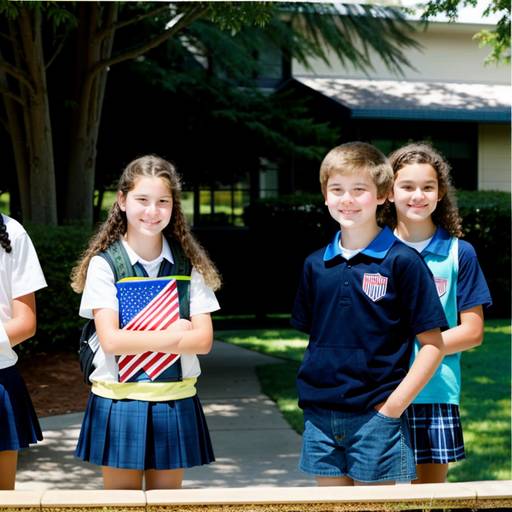
The 6th-grade curriculum encompasses a comprehensive range of subjects designed to foster critical thinking and a deep understanding of key concepts. In English Language Arts, students engage with diverse texts and develop their writing skills across narrative, persuasive, and research genres, while enhancing their vocabulary and grammar. The Mathematics component emphasizes number sense, algebraic reasoning, geometry, and data analysis, focusing on real-world applications. In Science, students explore Earth and Space Science, Life Science, and Physical Science through inquiry-based learning and hands-on experiments. The Social Studies curriculum introduces geography, history, government, and economics, helping students develop civic awareness and an understanding of societal structures. Overall, the curriculum aims to provide an engaging and enriching educational experience that prepares students for future academic endeavors.

The 7th Grade Curriculum encompasses a comprehensive approach to core subjects, including English Language Arts, Mathematics, Science, and Social Studies, along with Fine Arts, Physical Education, and Technology. Students develop reading comprehension skills through diverse literary texts, improve their writing proficiency with various styles, and enhance their grammar and vocabulary. In mathematics, they explore ratios, expressions, geometry, and statistics, fostering analytical thinking. The science segment covers Earth and space science, life science, and physical science, emphasizing practical inquiry and data analysis. Social studies focus on geography, historical events, civics education, and economic principles, cultivating informed and engaged citizens. Additionally, the curriculum promotes creativity in fine arts, active lifestyles in physical education, and digital literacy in technology, providing a well-rounded educational experience.

The curriculum for 8th grade encompasses a wide range of subjects aimed at fostering comprehensive educational development. In English Language Arts, students engage with diverse texts and enhance their reading, writing, and grammar skills while emphasizing research and inquiry. Mathematics instruction focuses on algebraic concepts, geometry, statistics, and problem-solving strategies, empowering students to tackle complex problems. The science component promotes inquiry-based learning across earth, life, and physical sciences, while social studies provides a historical perspective and insights into civics and global awareness. Physical education encourages active lifestyles and teamwork, complemented by health education. Fine arts education enables students to explore various artistic mediums, fostering creativity and cultural appreciation. Finally, technology education emphasizes digital literacy and ethical use of technology, preparing students for a connected, modern world.