
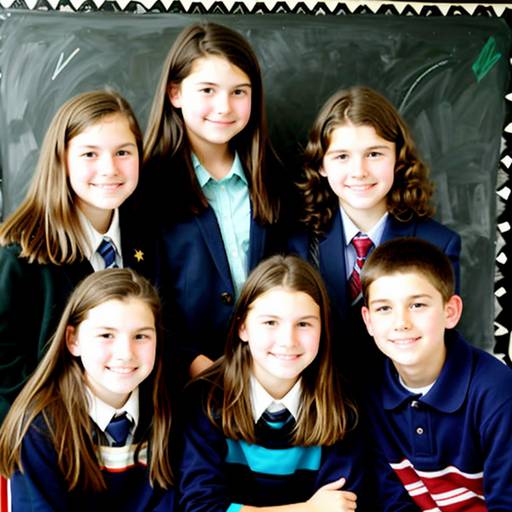
| Level | Middle School |
| Grade | 6th Grade |
| State | Kentucky |
| Age Range | 11 to 12 |
| Language | English |
Areas Of Development
As an educator, you strive to create an enriching and engaging learning environment that meets the diverse needs of your students. Our comprehensive 6th Grade Curriculum is designed not only to align with Kentucky academic standards but also to ignite a passion for learning in your classroom. Here’s a detailed summary of our curriculum that can help you inspire and empower your students across all subjects.
English Language Arts:
Our English Language Arts program fosters critical thinking and creativity through the exploration of both literature and informational texts. Students will learn to:
- Analyze characters, settings, and themes in literature.
- Develop narrative, informational, and opinion writing skills, allowing them to express themselves clearly and effectively.
- Enhance their speaking and listening skills through collaborative discussions and presentations.
- Expand their vocabulary and understanding of language conventions.
- Undertake research and inquiry projects to cultivate curiosity and information literacy.
Mathematics:
Our math curriculum emphasizes problem-solving skills and real-world applications. Key areas of focus include:
- Understanding ratios and proportional relationships to facilitate mathematical reasoning.
- Mastery of the number system, including fractions, decimals, and integers.
- Engaging with expressions and equations to foster algebraic thinking.
- Exploring geometric concepts and their applications in real life.
- Analyzing data through statistics and probability to make informed decisions.
Science:
The science curriculum encourages inquiry and exploration, preparing students for the wonders of the natural world. Students will:
- Investigate Earth and space science, delving into topics like ecosystems and climate.
- Conduct experiments in physical science, gaining hands-on experience in scientific inquiry.
- Explore the intricacies of life science, focusing on biological processes and systems.
- Engage in engineering design challenges that promote critical thinking and problem-solving.
Social Studies:
Our social studies program cultivates informed and engaged citizens. Key components include:
- Understanding geographical concepts and spatial thinking to navigate the world.
- Learning about civic responsibilities and government structures.
- Exploring economic principles and their relevance to everyday life.
- Analyzing historical events to understand their impact on the present and future.
Health:
- Nutrition and physical activity to promote lifelong healthy habits.
- Mental and emotional well-being, focusing on self-care strategies.
- Safety measures and injury prevention in various environments.
- Community health initiatives that encourage students to be proactive members of society.
Physical Education:
Our PE program promotes fitness and teamwork through a variety of activities. Students will:
- Develop fundamental movement skills and participate in diverse physical activities.
- Learn concepts of fitness and wellness, understanding their importance.
- Engage in team sports and cooperative games that foster collaboration and sportsmanship.
- Emphasize safety and rules to encourage responsible participation.
Fine Arts:
The fine arts curriculum nurtures creativity and self-expression. Students will explore:
- Visual arts techniques, allowing for imaginative creation.
- Music theory and performance, developing a deep appreciation for the art form.
- Drama and theatre arts, enhancing communication and confidence.
- Dance movements, promoting physical activity and artistic expression.
Technology:
In an increasingly digital world, technology literacy is essential. Our program includes:
- Lessons on digital citizenship and online safety, ensuring responsible technology use.
- Basic computer applications and an introduction to programming concepts.
- Information literacy skills that enable effective research and evaluation of sources.
- Media production techniques that allow students to present their ideas innovatively.